
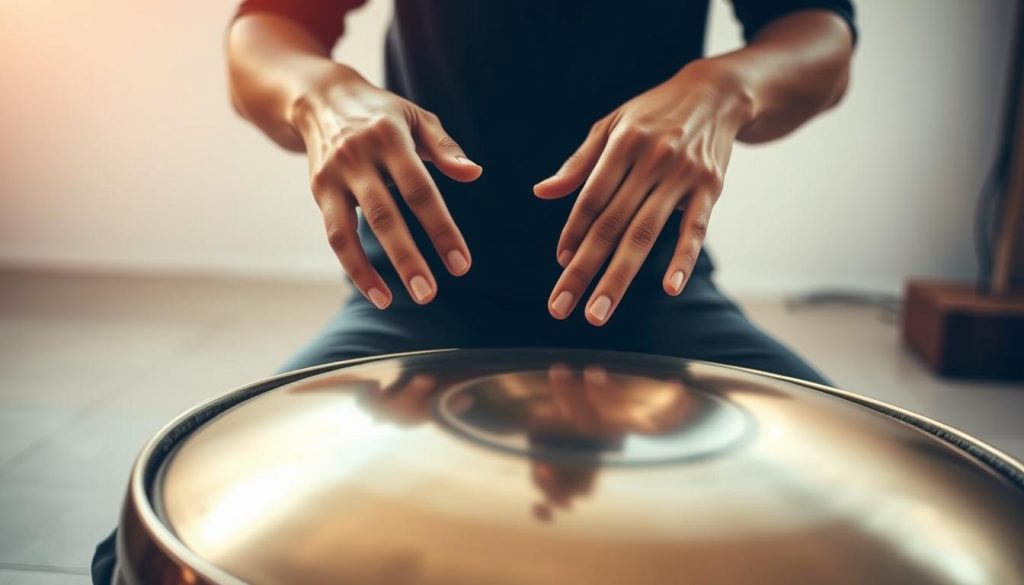
Discovering an instrument as unique as the handpan is a rewarding experience. Its enchanting sound and accessibility make it an ideal choice for beginners. However, mastering the basics requires a suitable method.
With immersive online courses, learning becomes intuitive. The MasterTheHandpan platform, for example, has already trained more than 38,000 players through its color-coded notation, which requires no knowledge of music theory. It is a fun approach for making rapid progress.
Whether you want to play for pleasure or develop your technique, starting with simple rhythms is essential. Discover how to incorporate varied tones to enrich your playing.
Introduction to the handpan and its rhythmic world
Invented in 2009 by Felix Rohner and Sabina Schärer, the handpan combines simplicity with harmonic richness. This steel musical instrument is distinguished by its central ding and 7 to 8 preset notes, which naturally produce melodies that sound in tune.
What is a handpan?
The handpan is a tuned steel shell made of two welded parts. Unlike the steel drum or pantam, its handcrafted construction explains its high price. Here is a key comparison:
| Instrument | Material | Scale | Average price |
|---|---|---|---|
| Handpan | Nitrided steel | 7 to 8 fixed notes | €1,500 to €3,000 |
| Steel drum | Standard steel | Adjustable notes | €500 to €1,200 |
Each area (or tonefield) produces a specific note, making it ideal for learning to play without knowing music theory. As one student explains:
“With structured lessons, I progressed three times faster than I did by teaching myself.”
Why start with basic rhythms?
Mastering simple patterns is the key to improvising later. Regular practice of fundamental rhythms strengthens coordination and listening skills.
For example, alternating between the ding and the surrounding notes creates a solid foundation. It is like learning to walk before you run.
What you need to get started properly
Fluid playing begins with a suitable, comfortable position. Setting up your instrument correctly helps prevent tension and unlock its full musical potential.
The ideal playing posture
Sit on a low chair with your knees slightly higher than your hips. Tilt the handpan 30° toward you to make the lower notes near your abdomen easier to reach.
This position provides optimal stability. Test whether you can reach every area by lightly touching the tonefields before playing.
Holding your handpan correctly
Use your fingers and the palm of your hand to maintain balance without gripping the instrument. A non-slip cushion can prevent unwanted movement.
Avoid tilting it too far, as this strains the wrists and reduces the quality of your strikes. A light touch is the key to sustainable practice.
Essential striking techniques
Mastering the handpan depends on precise techniques that unlock its full musical potential. Every movement affects the resonance and clarity of its sounds. Here is how to optimize your playing.
The ding and harmonic notes
The central ding produces the fundamental note. Strike it with your fingertips to obtain a clear sound. The higher surrounding notes are activated with the palm or knuckle.
Experiment with pressure: too much will dampen the vibrations, while too little will not provide sufficient projection.
Finger movements to master
Four techniques are essential:
- Fist: for powerful sounds.
- Knock: ideal for fast notes.
- Palm Mute: dampens the sound to create rhythmic effects.
- Slap: creates a percussive snap.
| Technique | Striking area | Sound effect |
|---|---|---|
| Fist | Between the tonefield and the dimple | Deep resonance |
| Knock | Outer edge | Short, precise note |
Exercises for improving accuracy
Practice the feather exercise: lightly brush the notes without damping them. Use a metronome to make your tempo more consistent.
To develop ambidexterity, alternate hands for 15 days. Compare the results achieved with finger and palm strikes.
Basic handpan rhythms for beginners: where should you start?
Making rapid progress requires an understanding of basic structures. Handpan melodies come alive through logical sequences that are easy to memorize.
The simple duple rhythm
Start with a 4-beat pattern, alternating between the central ding and the surrounding notes. The “hand tree” method improves coordination:
- Left hand: strike the ding on beats 1 and 3.
- Right hand: answer with the side notes on beats 2 and 4.
The triple rhythm
Divide each measure into 3 equal parts to produce a smoother flow. The drop-by-drop technique helps control transitions:
| Structure | Example | Effect |
|---|---|---|
| 1-2-3 | Ding → High note → Silence | Creates a dance-like pulse |
| 1-and-2 | Fast double strike | Adds dynamics |
Linking rhythmic cells
Combine two short patterns to form a complete scale. Use your body as a natural metronome by gently swaying your shoulders.
“Playing slowly at first helps embed each movement before you speed up.”
Progressive practice exercises
Methodical training is essential for developing musicality. With just 10 minutes of daily practice for 30 days, progress becomes tangible. The key is to alternate between technical exercises and moments of creativity.
Ascending and descending scales
Begin by exploring every note on your instrument. Play them in ascending and then descending order while maintaining a steady beat. This exercise sharpens listening skills and accuracy.
The MasterTheHandpan guide offers progressive combinations:
- Scales in thirds for practicing intervals.
- Slow arpeggios for strengthening muscle memory.
Tempo variations
Apply the “5-4-3-2-1” method: play a 5-beat pattern, then gradually reduce the number of beats to 1. Use a metronome to adjust the speed without sacrificing sound quality.
Record yourself regularly. Self-analysis reveals your progress and areas for improvement.
Creating your first patterns
Combine two random notes to form a rhythmic cell. Add a creative constraint: for example, use only the lower notes. These simple melodies will become the foundation of your improvisations.
One player explains:
“With 20 hours of focused practice, I developed solid instincts for composing freely.”
Common mistakes to avoid
Playing the handpan requires finesse. Certain mistakes can hinder your progress or damage the instrument. Here is how to identify and correct them.
Striking too hard or too quickly
Excessive pressure can deform the metal over time. Here are 5 types of irreversible damage caused by poor technique:
- Deformed tonefields
- Microscopic cracks
- Loss of accurate tuning
- Premature coating wear
- Gradual detuning
Use the “3-second” method: after each strike, count to 3 to check the resonance. A clean sound should ring out naturally.
“My first handpan lost its magic in 6 months because I struck it too forcefully. The repair cost €450.”
Neglecting consistent practice
Ten minutes every day is better than 2 hours of sporadic practice. Here is a discouragement-proof program for occasional players:
| Day | Goal | Duration |
|---|---|---|
| 1 to 7 | Exploring the notes | 8 min |
| 8 to 14 | Linking 2 rhythms | 12 min |
The professionals’ tip? Perform a post-strike resonance test: if the note fades too quickly, adjust your technique. Good practice preserves the instrument and accelerates progress.
Resources for going further
Deepening your mastery of the handpan requires the right tools. Here is a selection of reliable resources for making progress, whether you prefer structured courses or free content.
Premium learning platforms
The MasterTheHandpan Academy offers comprehensive support:
- A private community with daily discussions
- Annual masterclasses with experts
- 14-day money-back guarantee
Comparison of the 3 best options:
| Platform | Benefits | Cost |
|---|---|---|
| Handpan Dojo | Progressive learning path | €29/month |
| Pantam School | Specialized courses | €197/year |
| MasterTheHandpan | Unlimited access | €497 for lifetime access |
High-quality free content
Get the most out of YouTube videos with this technique:
- First, watch each video all the way through without your instrument
- Reproduce the movements in slow motion
- Write down recurring patterns
Recommended channels:
- Handpan France — Tutorials for beginners
- Sound Meditation — Advanced techniques
- Urban Notes — Analyzed live sessions
“David Charrier’s workshops saved me 6 months of independent practice.”
Conclusion: toward a fulfilling handpan practice
Your journey with this instrument can transform your relationship with music. By mastering posture, techniques, and rhythmic patterns, learning becomes a source of daily enjoyment.
From 20 to 200 hours of playing, every stage reveals new melodies. Join local or online communities to exchange tips and inspiration.
As one music therapist explains: “The handpan gave me an unexpected new career, combining musical experience with well-being.”
Ready to make progress? Try our free 7-day program to explore your potential.