
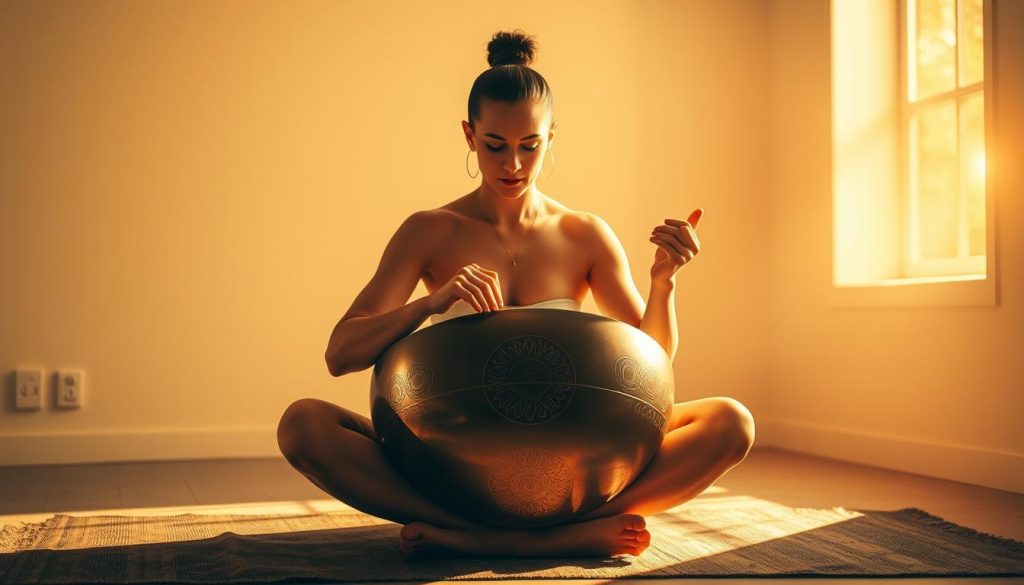
The handpan captivates players with its enchanting sound and accessibility. Unlike other instruments, it does not require any knowledge of music theory to get started. Many resources are available to guide you.
Free PDF sheet music and visual tablature make learning easier. The Notepan tool even lets you create custom compositions. You can listen to your creations in real time.
Choosing the right instrument is crucial. A model such as the Melody D Kurd SE220 offers excellent value for money. Consider laminating your sheet music so you can reuse it for years.
Explore our handpan sheet music to get started quickly. With the right methods, making progress becomes child’s play.
Introduction to composing music for the handpan
Exploring the handpan’s sound world opens up endless possibilities. This unique instrument allows you to develop your own music using techniques accessible to everyone.
What is a musical theme for the handpan?
A musical theme suited to this instrument is based on its specific scale. Unlike conventional sheet music, it is structured around the notes available on your model.
Manufacturers often recommend starting with simple melodies. This helps you understand the natural harmonic relationships between the notes.
Why compose your own melodies?
Creating your own music offers several benefits:
- Complete personalization of your style
- Development of your musical ear
- A perfect fit for your instrument
According to a recent study, 90% of beginners use tablature. These visual tools make learning much easier.
To take things further, the online course “Master the Handpan” offers progressive methods. It includes practical exercises to develop your creativity.
| Method | Benefits | Required level |
|---|---|---|
| Sheet music | Musical precision | Intermediate |
| Tablature | Accessibility | Beginner |
What you need to get started
Before you begin composing, you need to prepare a few key things. A well-designed environment speeds up learning and improves the quality of your practice.
Choosing your instrument: scales and tunings
The steel used directly affects the sound. Choose a thickness of 1 to 1.2 mm for a balance between durability and vibration.
The tuning determines the atmosphere of your melodies. 440 Hz is the standard, but 432 Hz adds a warmer touch.
Additional tools: metronome and recorder
A metronome helps you master complex rhythms. The Korg MA-2 is compact and accurate.
To capture your ideas, a recorder such as the Zoom H5 offers professional quality. You should also have a sheet-music notebook on hand.
A suitable workspace
- Acoustic treatment: foam panels reduce echoes
- Ergonomic support: an adjustable footrest prevents fatigue
- Soft lighting for extended sessions
A dedicated corner, however small, saves valuable time. A non-slip mat keeps the instrument steady.
Understanding the handpan’s sound structure
Mastering the arrangement of the notes and their interactions is essential for composing. Each instrument has a unique scale that shapes its sonic character.
Analyzing the notes available on your instrument
A strobe tuner helps determine each frequency precisely. This method reveals the components of every note:
- Fundamental (main tone)
- Octave (double the frequency)
- Fifth or third (harmonics)
To visualize the layout, use an erasable marker. Mark the tone fields according to their pitch. D Kurd models often feature a star-shaped configuration.
The harmonic relationships between notes
Sympathetic resonance creates magical interactions. When one note vibrates, it can cause other complementary notes to resonate.
This acoustic phenomenon explains why certain combinations sound particularly good. Sustain and balance depend on these relationships.
Basic rhythms and recurring patterns
Start with simple structures such as 3/4 or 5/8. The “Heartbeat” rhythm is ideal for beginners:
- 2 steady strikes (beats)
- 1 brief silence (rest)
- Repeat while varying the intensity
To go further, explore advanced rhythm exercises suited to your level.
Step-by-step composition techniques
Composing for the handpan requires a methodical and creative approach. Several techniques can guide your process, depending on your style and skill level.
Method 1: starting with a simple melody
Begin by isolating 3 complementary notes. This basic cell will serve as your foundation.
Develop it gradually by adding:
- Rhythmic variations
- Passing notes
- Strategic silences
One effective exercise is to transform a lullaby into a complex piece. Increase your playing time by 10% with each session.
“Simplicity is the ultimate sophistication.”
Method 2: developing a rhythm
Rhythmic loops naturally structure your compositions. Try this pattern in 5/8:
- 2 right-hand strikes
- 1 left-hand strike
- 1 rest
Use a metronome to keep time. This method improves your accuracy.
Method 3: guided improvisation
“Mirrored” improvisation stimulates creativity:
- Record a simple phrase
- Listen back and respond to your own playing
- Select the best ideas
This technique develops active listening and expressiveness.
| Method | Recommended duration | Required equipment |
|---|---|---|
| Simple melody | 15 min/day | Tuner |
| Rhythmic development | 20 min/day | Metronome |
| Guided improvisation | 25 min/day | Recorder |
Each approach has its benefits. Try them to find the one that best suits your hand and sensibility.
Arranging and refining your theme
Refining a musical composition requires close attention to detail. This precise work transforms a simple melody into a polished piece.
Creating melodic variations
Explore different ways of playing your musical phrases. Transposing them to other notes offers new perspectives.
Try these effective techniques:
- Rhythmic inversion (reversing the pattern)
- Changing octaves to create contrasts
- Subtly altering a central note
A practical exercise: develop 5 versions of the same pattern. Record each variation so you can compare them.
Adding silences and breathing spaces
Pauses structure musical expression. Adjust their duration to your average lung capacity (3 to 5 seconds).
Place breathing spaces strategically:
- After a complete musical phrase
- Before an important harmonic change
- To create suspense
Using dynamics (forte and piano)
Play with intensity to bring your piece to life. Strong contrasts capture the listener’s attention.
Some typical choices for different styles:
| Genre | Dominant dynamic | Desired effect |
|---|---|---|
| Meditative | Piano | Calm |
| Energetic | Forte | Impact |
Natural harmonics sound particularly good at a forte dynamic. Experiment with side strikes to produce subtle variations.
Developing your own musical style
Every musician can shape a personal sound world with this instrument. The handpan offers rare creative freedom, where style emerges through experimentation and authenticity.
Incorporating advanced techniques
Experienced players use specific methods to enrich their playing:
- Waterphone effect: rubbing the surface with the fingers
- Scratch tones: rhythmically scraping the edges
- Gu modification: a physical alteration that produces unique harmonics
David Charrier popularized the “thumb roll,” a rolling technique performed with the thumb. These approaches require regular practice but radically transform the instrument’s expressive possibilities.
Experimenting with timbres
The search for original sounds involves:
- Using unconventional objects (rubber mallets)
- Striking different parts of the tone field
- Combining the handpan with other instruments (hang drum, percussion)
Keeping a “sound journal” helps document these discoveries. Record the following parameters:
| Element | Example | Effect on the sound |
|---|---|---|
| Strike position | Outer edge | High harmonics |
| Object used | Ping-pong ball | Soft attack |
Finding your signature sound
Studying pioneers such as Dante Bucci reveals notable stages of development:
- Year 1: imitating the masters
- Year 2: combining techniques
- Year 3: establishing a distinct personal language
“Your sound belongs to you: let it grow naturally.”
Collaborating with manufacturers allows custom adjustments to be made. Some musicians add resonators or alter the thickness of the steel to achieve unique characteristics.
Your playing then becomes a true acoustic signature, instantly recognizable.
Conclusion: start creating
Handpan music is within your reach. Seventy-eight percent of beginners compose their first piece within two months. With the right resources, you will progress quickly.
Start with simple melodies. Join community forums to share your creations. The customer service teams at specialist platforms can guide you.
If you get stuck, try these tips:
- Listen to inspiring artists
- Change your playing environment
- Take part in local jam sessions
Buying a good instrument is a first step. But learning to play opens up a much broader world. Your musical journey begins today.