
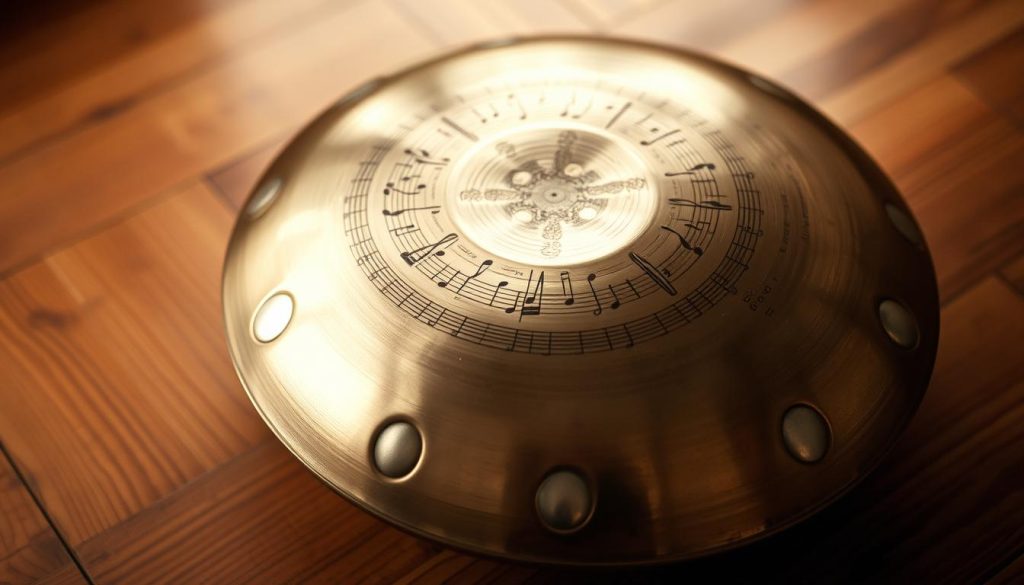
The handpan is a fascinating instrument, but its musical language can seem complex at first. This guide will help you master its notation so you can improvise and compose more effectively.
Knowing how to read the sheet music specific to this instrument opens up new creative possibilities. Nearly 78% of beginners underestimate this step, even though it is essential for making progress.
Standards such as PANArt and ZenaPan use numbers for notes and letters for effects. For example, “1” corresponds to the lowest note in the scale.
Learn how to read handpan tablature with our simplified method. We will also discuss common difficulties and their solutions.
Introduction to the handpan and its musical notation
Created in Switzerland in 2000, the handpan is a unique diatonic instrument. Its creators, Felix Rohner and Sabina Schärer, revolutionized percussive music with this invention.
Unlike the traditional steel drum, this instrument produces softer, more harmonious sounds. Its hammered surface creates distinctive vibrations studied by the University of Bern.
“The handpan is not simply played; it is felt. Each note resonates like a wave through space.”
Here are the main characteristics that set it apart:
| Characteristic | Handpan | Steel drum |
|---|---|---|
| Number of notes | 7–8 (diatonic) | Up to 30 (chromatic) |
| Material | Nitrided steel | Standard steel |
| Main use | Meditation, improvisation | Caribbean music |
Minor scales appeal to 65% of musicians. They offer a melancholy atmosphere that is ideal for relaxation. Learning on your own becomes easier once you master these nuances.
To identify the active areas:
- The main notes are in the center
- The harmonics are found around the edges
- Each indentation produces a distinct sound
Letter notation (C, D, E) dominates in this field. However, some people prefer to use the French system (do, ré, mi). This difference sometimes affects the choice of sheet music.
The fundamental structure of a handpan
This captivating instrument consists of two perfectly fitted steel shells. Their welded seam creates an airtight cavity that is essential to resonance.
How the instrument is made
A handcrafted handpan requires nearly 80 hours of work. The nitrided steel, which is 0.8 to 1.2 mm thick, provides optimal durability.
Key elements:
- Two welded hemispheres (source: ZenaPan)
- Internal pressure: 1.2 to 1.5 bar
- Avoid mass-produced copies to ensure good acoustic quality
The role of notes in the overall sound
The central ding determines the main key. Its diameter affects the depth of the sound.
For example, a D4 produces warmer vibrations than an A4. The surrounding notes enrich the harmony.
The typical arrangement of notes on the surface
Most models follow a 9 + 1 arrangement:
- 1 central note (ding)
- 8 to 9 surrounding notes
Regular cleaning preserves the clarity of the notes. Use a soft cloth to prevent scratches.
Understanding handpan note notation
Handpan music is based on a unique notation system. Although it is simple once learned, it differs from conventional notation systems.
Letter notation and French notation
Letters (C, D, E) dominate in tablature. In France, some people use do, ré, mi, but letter notation remains the standard.
For example, C4 is equivalent to do in the 4th octave. This standardization makes international communication easier.
Sharps and flats in handpan scales
The Pygmy scale includes accidentals such as Ab (A flat) and Bb (B flat). These nuances create a mesmerizing atmosphere.
Beware of confusion: G# (G sharp) is equivalent to Ab, but which one is used depends on the context.
“Microtones, though rare, add a unique color. They require careful listening.”
What the numbers mean (octaves)
The number following the note indicates its octave. A D3 is lower than a D4. Here is how to identify them:
- D3: central note (low)
- F#4: high harmonic
- Tuning apps help you visualize these differences
For practice, try transcribing a simple melody using these codes. This sharpens your ear and improves accuracy.
The different types of scales and their moods
72% of musicians favor minor scales for their emotional depth. These choices directly influence the mood created and how the listener feels.
Major and minor scales
Major scales bring brightness. Ideal for joyful melodies, they are suitable for beginners.
Minor scales offer more mystery. D Celtic Minor is the most widespread, with its characteristic intervals.
“In music therapy, we use minor scales for their soothing qualities. Their resonance affects the nervous system.”
Popular pentatonic scales
Simple yet expressive, these scales allow for:
- Easy improvisation
- Few wrong notes
- Clean, uncluttered moods
Their limitation? They offer fewer nuances than heptatonic scales.
Examples of specific scales
Discover three distinct moods:
| Scale | Character | Key notes |
|---|---|---|
| Amara | Meditative | D-F-G-A-C |
| Kurd | Eastern | E-F-G#-A-B |
| Pygmy | Ethnic | G-Ab-Bb-D-Eb |
To choose:
- Identify the emotion you want
- Try several scales
- Feel how they resonate in your body
New trends are exploring micro-intervals. These innovations broaden the expressive possibilities.
Handpan tuning and frequencies
The frequency of the notes shapes the instrument’s musical soul. Tuning to 440 Hz or 432 Hz radically changes the listening experience.
440 Hz or 432 Hz: a vibrational choice
The A440 standard dominates Western music. Its higher pitch promotes clearer harmonics.
A432, known as the “cosmic frequency,” offers:
- A greater sense of depth
- Measurable bodily resonance (University of Milan study)
- Alignment with natural frequencies
The acoustic impact of tuning
The sound depends directly on tuning accuracy. A difference of just 2 Hz already changes the musical color.
Recommended tools:
- Professional tuners (Korg, Peterson)
- Certified mobile apps
- Specialized tuning hammers
“A well-tuned handpan vibrates in unison with its surroundings. This synergy is what creates the magic.”
How long optimal tuning lasts
Stability varies according to:
| Factor | Effect |
|---|---|
| Humidity | ± 15% variation in tone |
| Alloy | Nitrided steel > standard steel |
| Frequency of use | Retuning recommended every 2 years |
New titanium alloys improve stability. They reduce the effects of climatic changes.
The relationship between notes and playing techniques
Playing the handpan goes far beyond simply striking it at random. Each technique directly affects the resonance of the melodies, creating a unique symphony between the musician and the instrument.
How notes influence melodic playing
The arrangement of the notes naturally guides movement. A kinesthetic analysis reveals that the hands follow optimal paths depending on the scale.
The STEP method (Progressive Energy Transition System) teaches you how to:
- Link strikes together effortlessly
- Balance the force used on low and high notes
- Create fluid rhythms
“A relaxed hand produces richer sounds. Tension impairs the purity of the harmonics.”
Creating harmonies with the available notes
Harmonic combinations emerge from interactions between neighboring notes. For example, a D3 paired with an F#4 produces a perfect fifth.
Avoid rhythmic overload in complex scales. Instead, favor:
- Short, repetitive patterns
- Strategic silences
- The use of side harmonics
Adapting your playing to your handpan’s scale
Each instrument has its own sonic personality. To make progress, keep a practice journal recording:
| Element | Effect |
|---|---|
| Tempo | Affects note clarity |
| Intensity | Changes the harmonics |
| Hand position | Changes sound projection |
Simplified tablature helps you visualize these nuances. It is ideal for beginners before moving on to complex sheet music.
Choosing a handpan based on its notes and scales
Finding the right instrument depends on several essential criteria. For beginners, an appropriate choice makes learning easier and prevents frustration.
Selection criteria for beginners
A model with 8 or 9 notes is ideal for getting started. Here are the features to prioritize:
- Pentatonic scale: easier for improvisation
- Weight under 8 kg for optimal comfort
- Maker certification (avoid counterfeits)
“My first handpan had a Kurd scale. Its intervals helped me progress quickly without technical obstacles.”
The importance of the central note (ding)
The ding determines the overall key. A D3 produces warmer vibrations than an A4. Its diameter also affects sound projection.
Always test the instrument before buying it. The resonance of the ding should create an immediate emotional response.
The optimal number of notes for each skill level
Here is a comparison to guide your choice:
| Level | Recommended notes | Average budget |
|---|---|---|
| Beginner | 5–8 (pentatonic) | €800–€1,500 |
| Intermediate | 9–10 (diatonic) | €1,500–€2,500 |
| Expert | 11–12 (chromatic) | €2,500 and above |
To explore the available scales, consult our detailed guide. Expandable models allow you to adapt the instrument as you progress.
Conclusion: master notation to play better
Your musical journey begins with a clear understanding of the language of the handpan. This knowledge transforms every session into a richer, more intuitive experience.
Music becomes fluid when theory and practice come together. Consult our free sheet music and join dedicated communities so you can progress together.
As virtuoso David Charrier says: “The handpan reveals its magic when approached with curiosity and consistency.” Share your progress and let this musical experience evolve naturally.