
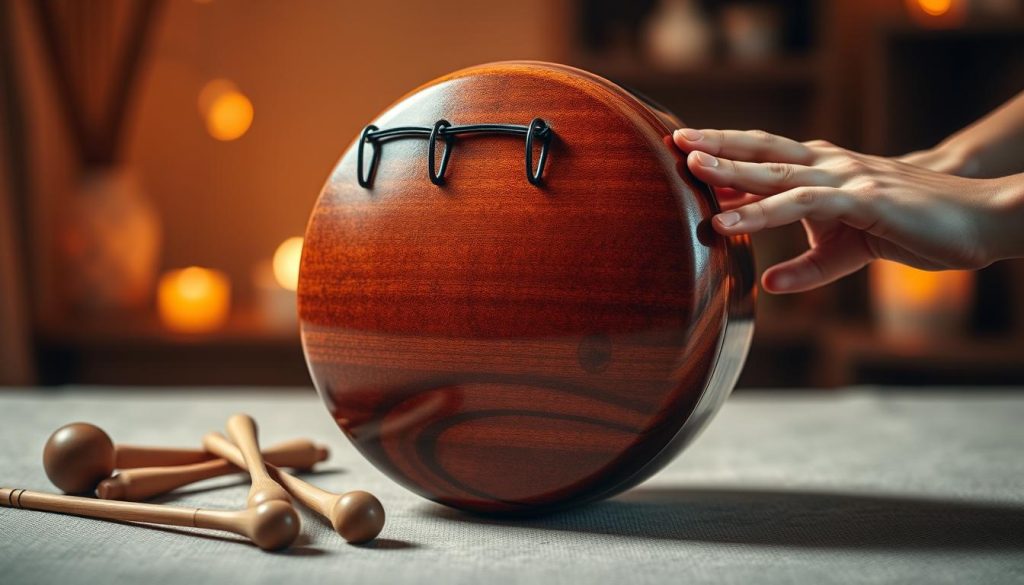
Discover how to choose between two ways of playing this modern instrument.
Invented by Dennis Havlena in 2007 from a propane tank, the tongue drum quickly gained popularity thanks to its simplicity.
This article is a practical guide to getting started and optimizing your experience.
Regularly playing a musical instrument reduces stress and helps you relax. Beginners can produce soothing sounds within the first few minutes.
Our guide explains how each technique affects sound projection and harmonic richness. Making the right choice prevents frustration and speeds up progress.
To learn more, read a complete introduction and the history of this instrument in our detailed guide.
Understanding how the tongue drum works
This modern instrument is based on a simple principle: cut-out plates vibrate inside a hollow body to produce precise sounds.
Origins and design
Its roots go back to slit drums used by several civilizations more than 500 years ago. In 2007, Dennis Havlena reinvented the concept by cutting tongues into a propane tank.
Resonance mechanism
It works through the vibration of steel: each tongue has a size that determines its note. The larger the tongue, the lower the sound.
“The resonating chamber amplifies the vibration to produce between 70 and 80 decibels, depending on the strike.”
- The tuning of the tongues determines the quality and accuracy of the notes.
- The number of tongues generally ranges from 6 to 15, which affects the available scales.
- Unlike handpans, its visible construction features grooves rather than hammered indentations.
In practice, this design makes the instrument intuitive to use. Even without musical experience, you can quickly produce beautiful tones.
Tongue drum with mallets or fingers: the comparison
When getting started, it is best to understand the trade-offs between price, expressiveness, and durability.
Price and accessibility: a tongue drum costs between €22.90 and €499 at La Baguetterie, whereas a handpan may cost from €999 to €2,999. This difference is explained by the handpan’s complex tuning process.
Construction changes everything. A handpan requires expert tuning and has a delicate structure. A tongue drum is easier to manufacture and more resistant to thermal shock.
Playing and expressiveness: playing a handpan with your hands provides a unique dynamic range. By contrast, mallets make the tongue drum versatile and accessible.
“Each hand plays a crucial role in playing accurately.”
For a comprehensive guide and a useful tongue drum comparison, read our article. Your choice will primarily depend on your budget and experience.
Preparing your instrument for optimal playing
Careful setup optimizes note projection and preserves the quality of your instrument. Before playing, check that the table is stable and its surface is clean.
Setup and accessories
Rubber feet: essential for preventing the shell from touching the table and muffling the resonance. Check their condition regularly to prevent slipping.
“Donut” cushion: a model suited to the instrument’s diameter raises it off the surface. It improves comfort and access to the notes during long sessions.
- Place the instrument on a stable table to ensure optimal resonance.
- Use numbered stickers on the notes to make learning easier, especially when following a tutorial.
- Check the tuning before each use so you can explore the scales more effectively.
The number of notes on your model affects the complexity of the pieces you can play. If in doubt, consult a practical guide or follow a dedicated tutorial to adjust its position and maximize comfort.
Organize your playing area: good lighting, a suitable seat, and dedicated practice time improve both the experience and sound quality. To compare it with other instruments such as the handpan, read our article: the difference between a handpan and a tongue drum.
The benefits of playing with mallets
Playing with mallets provides a clear, repeatable attack. This consistency is perfect for beginners who want immediate sonic results. The impact is clean and makes every note easy to hear.
The rubber head of each mallet rebounds naturally. This rebound prevents prolonged contact that would dampen the steel’s vibration. The sound consequently gains harmonics and sustain.
“A standardized attack makes learning easier and builds musical confidence.”
- Projection: greater sound reach when playing in a large space.
- Consistency: identical attacks and fewer mechanical errors.
- Relaxation: an immersive atmosphere at a controlled volume.
| Aspect | Mallets | Hand playing |
|---|---|---|
| Projection | High | Softer |
| Attack control | Standardized | Variable |
| Harmonics | Clear and long | Warm but shorter |
Mastering mallet technique for greater accuracy
A relaxed, controlled grip is the key to producing clear, consistent notes. This method encourages the mallet to rebound naturally from the steel, keeping every strike clear and even.
Grip
Position your thumb and index finger so they guide the mallet without squeezing it. Let the head rebound; do not press it against the tongue. Keep your shoulders lowered and your wrists relaxed to avoid tension.
Coordination exercises
Short routine: 5 minutes a day is enough to progress faster than with long, irregular sessions.
- Alternate L‑R‑L‑R across two notes to work on accuracy.
- Use a metronome at 60 BPM to improve your consistency.
- Repeat each exercise several times until the movement becomes automatic.
“Coordination between the two hands improves over time, allowing you to play sequences smoothly.”
With a high-quality steel instrument, the response to every strike is immediate. The accuracy you develop lets you fully explore its scale and enrich your musical experience, regardless of the number of notes.
The challenges of finger playing for beginners
Learning to strike and then release quickly transforms the experience and prevents a dull sound. The main problem is prolonged contact, which dampens the vibration of the metal tongue.
Unlike a handpan, the metal is often thicker. You therefore need a distinct impact and a quick, almost flicking movement to trigger the note.
Your choice of striking area affects the tone color: use the center for a rounded timbre and the inner edge for brighter harmonics.
To progress, invest in a good instrument: stable tuning and responsive tongues make learning easier.
- Strike and then release immediately to free the resonance.
- Work on the speed of the movement rather than its force.
- Correct a dull sound by controlling the contact time.
“Hand technique requires patience but offers subtle expressiveness.”
| Challenge | Recommended action | Expected effect |
|---|---|---|
| Prolonged contact | Release quickly | Clear note |
| Thick metal | Quick movement | Better attack |
| Striking area | Test the center and edge | Different tone color |
For step-by-step exercises, see how to play a wooden tongue drum and adapt the method to your own playing.
Essential movements for playing your first notes by hand
Natural hand placement makes learning easier and helps you produce clear sounds sooner. Adopt a relaxed posture to prevent fatigue and improve accuracy.
Hand positioning
Neutral wrists: keep them relaxed to allow fluid movement. Relaxed shoulders reduce tension and the risk of fatigue.
The pad of the finger produces a soft, muted sound. The last joint provides a clearer, more percussive attack.
- Strike lightly with the fingertip pad for a rounded timbre.
- Use the finger joint to produce a crisp attack on each note.
- Place the instrument on a stable table for better support and consistent resonance.
Surface and size: steel responds differently depending on where it is touched. Explore the center and edge to vary the tone color.
“Good resonance depends on a brief impact: a quick movement releases the vibration without damping it.”
Protect the tuning by avoiding violent impacts. Practice these movements regularly: after a few sessions, your experience and the quality of your notes will improve.
Differences in tone and musical expression
In the same piece, the perceived timbre can range from powerful to intimate depending on the playing method.
Mallets provide strong projection and high volume. They are well suited to concerts and open spaces. Their sound highlights harmonics and sustain.
Hand playing reveals subtle nuances. Quick touches and ghost notes enrich the texture. This sound is ideal for relaxation or small-group sessions.
The handpan often has more tone fields—sometimes as many as 21—which expands its range and harmonic richness. The tongue drum generally produces a more muted, deeper sound that is perfect for meditative settings.
“The choice between power and softness depends on your goal: a public performance or an intimate moment.”
- Projection or nuance: high volume or subtle expressiveness.
- Scale and key: major for brightness, minor for emotion.
- Experience: mastering both techniques multiplies your sonic possibilities.
Advanced techniques for sculpting sound
Simple but precise movements open the door to a new palette of sounds on your instrument.
Damping effect
Damping involves briefly touching a vibrating tongue to stop the note abruptly.
This creates precise, percussive phrasing. The movement must be quick and relaxed so it does not dampen the instrument’s overall resonance.
Wah-wah modulation
Wah‑wah modulation is produced by partially covering the opening beneath the shell with your thigh or hand.
Changing the size of the opening modulates the sound’s volume and color. This technique adds unique expression to every note.
- These techniques let you sculpt sounds for a more percussive or singing quality.
- The accuracy of the hand affects the quality and consistency of the impact.
- The number of available notes does not limit creativity: you can vary the color on every surface.
“Mastering these movements transforms the instrument into an almost limitless source of musical nuance.”
Choosing a model for your playing style
The right model should first match the way you play and the musical atmosphere you want to create.
Size matters: a 40 cm model provides deeper bass and long sustain. A smaller model prioritizes speed and maneuverability.
The number of notes affects the complexity of the pieces you can play. To perform varied sheet music, choose 11 notes or more. Also consider the tuning and steel, which ensure a lasting experience.
- Relaxation-focused style: favor a minor scale and generous diameter.
- Melodic playing: choose more notes and ample spacing between the tongues for hand playing.
- If you are unsure: compare this model with the tongue handpan to confirm your choice.
“Test it in a real playing situation: the size, scale, and tuning reveal which instrument suits you.”
| Feature | 40 cm | 20 cm | Recommendation |
|---|---|---|---|
| Number of notes | 8–15 | 6–9 | 11 or more for sheet music |
| Sustain | Long | Short | Choose 40 cm for deeper bass |
| Use | Relaxation, performance | Practice, speed | Choose according to your style |
To explore the concepts of scale and key in greater depth, read our guide. Dennis Havlena paved the way for the creation of many models, and it can be useful to try several sizes before purchasing.
Conclusion
In short, the best method is the one that makes you want to play every day.
Your choice depends on your goals and skill level. Each technique offers unique qualities for exploring the nuances of the tongue drum and enriching your musical experience.
Regular practice remains the key to mastering this musical instrument and unleashing your creativity. This article was intended to help you make your decision with confidence.
Remember: what matters most is the pleasure of playing and the relaxation provided by the vibration of the steel. Enjoy the music and your progress.