
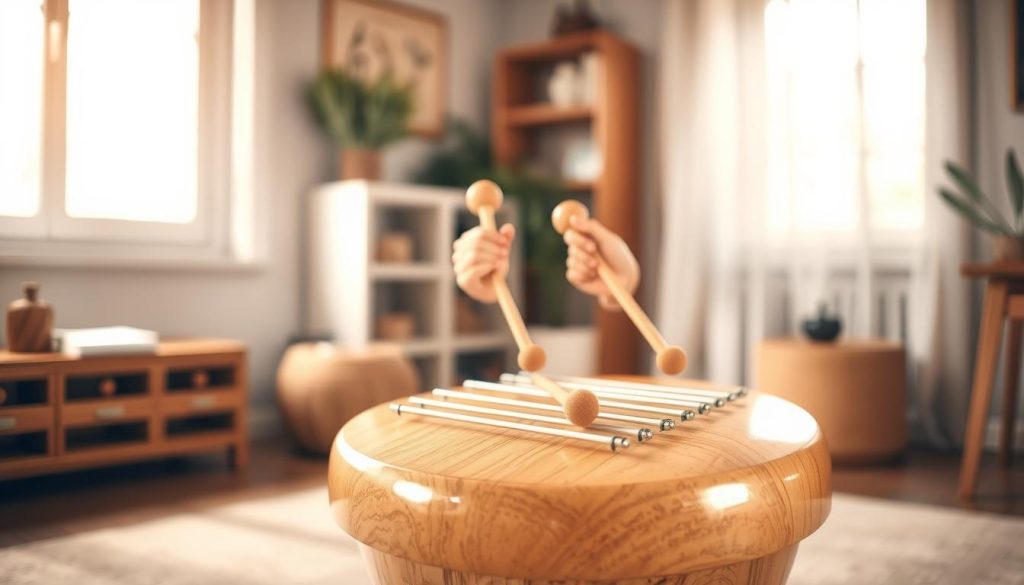
Welcome to this guide designed for beginners in France. After nearly ten years spent collecting and testing several instruments, I am sharing a clear, progressive method.
No knowledge of music theory is required. You will learn easy movements that quickly turn isolated strikes into soothing musical phrases.
This guide offers precise steps to help you avoid common mistakes. You will find advice on posture, choosing mallets, and linking notes together.
Goal: play simple, relaxing melodies today, following a methodical progression suitable for adults and teenagers.
Why Choose the Tongue Drum When Starting Music
The tongue drum appeals to beginners because it is quick to learn and produces soothing sounds. This percussion instrument produces clear tones without requiring prior knowledge.
Each note is tuned to a consistent scale. This allows you to create harmonious melodies without complex music theory.
Community matters: more than 38,000 players use the Masterthehandpan method. New students benefit from a 14-day money-back guarantee.
Compared with the often-expensive handpan, this instrument remains affordable. It offers rich tones and quick encouragement by producing crystal-clear sounds from the very first minutes.
- Accessible: few mistakes are possible, making it ideal for beginners.
- Reliable: a method recognized by a large community.
- Risk-free: try it without risk thanks to the 14-day guarantee.
To learn more about its features and purchasing one, read our complete guide.
Prepare Your Instrument for the Best Learning Experience
Before playing, take time to organize your instrument and practice space. This simple step improves listening and preserves its sound over time.
Positioning Visual Markers
Place numbered stickers on each tongue so you can identify the notes quickly. Follow the manufacturer’s guide to align each sticker with the central part of the steel tongue.
These markers help you memorize the order of the notes and reduce hesitation when linking them together.
Choosing a Suitable Stand
A good stand allows the instrument to resonate freely. A ring-shaped cushion or adjustable stand lets the tongue drum vibrate naturally.
- Avoid hard surfaces without rubber pads, as they dampen the resonance.
- Position the instrument on your thighs or on a stable stand so that you can reach every note comfortably.
- Make sure it is stable to ensure precise strikes during every session.
For a comparison between the handpan and tongue drum, read this guide.
Tongue Drum Tutorial: Simple Exercises to Get Started
Ten well-focused minutes are enough to familiarize your hands with the instrument. Repeat a short routine every day to memorize the position of each note and build confidence.
Going Around the Circle
Going around the circle involves striking each tongue in order. Start slowly, then increase the tempo to develop consistency.
This method develops a steady tempo and helps identify notes that require more attention.
The Ascending and Descending Scale
Practice the ascending scale and then the descending scale on a stable surface. This ensures consistent sound quality for every note.
Use the numbered notation supplied with your instrument to structure your sequences and track your progress.
Precision Exercises
Focus on clean strikes and resonance. A good stand frees the harmonics and makes each session more rewarding.
“Repeating short routines is the key to mastering the note layout.”
To go further, consult the beginner RAV/VAST course and incorporate these principles into your daily practice minutes.
Mastering Strikes and Sound Control
Learning to control your strikes transforms a series of sounds into an expressive musical phrase.
The striking technique taught by experts such as David Charrier produces a round, deep sound. Strike slightly toward the inside of the tongue for a more powerful note.
Aiming toward the outside produces a softer tone. Vary your force and precision: this instrument responds to the impact.
Also learn to mute the sound by briefly placing a finger on the tongue. This movement creates clean silences and strengthens the rhythm.
“Mastering dynamics transforms a succession of notes into a musical phrase.”
Compared with the handpan, the tongue drum requires an approach suited to the thickness of its metal. These subtleties make your playing more expressive.
| Action | Sound Effect | Quick Tip |
|---|---|---|
| Inner strike | More powerful, richer note | Use a firm, controlled attack |
| Outer strike | Soft tone | Soften the impact and play more lightly |
| Muting | Clean silence, rhythmic effect | Briefly place a finger on the tongue after striking |
These techniques and movements help you transform isolated notes into expressive phrases. For a practical example, try this guide to playing Amazing Grace.
Choosing Between Mallets and Finger Playing
Mallets or hands: each option requires a specific approach to movement and listening.
Mallets are recommended for beginners. Their natural rebound makes it easier to produce a clear, powerful sound.
Playing with your hands requires a quick, brief technique. You must strike without damping the vibration so that the resonance is preserved.
Hand-Striking Technique
Playing this instrument with your fingers is more demanding than playing a handpan. The metal is harder and requires precision.
Use the bony part of your knuckles to flick the surface of the tongue. This movement produces a precise, resonant note.
Regular practice develops the dexterity needed to alternate between mallets and hands according to the atmosphere you want to create.
| Option | Advantage | Tip |
|---|---|---|
| Mallets | Clear sound, controlled volume | Choose a soft head for greater rebound |
| Hands (knuckles) | Dynamic control and nuance | Strike briefly and cleanly without pressing down |
| Alternating | Variety of tone colors | Practice short exercises every day |
Each technique affects the tone color of your instrument; experiment and adapt your playing to the notes you want to emphasize. To learn more, read our complete tongue drum guide.
Building Your First Melodies and Chords
A melody often begins with a simple pair of notes that naturally sound good together.
Start by striking two neighboring tongues and listening to their harmony. This simple movement creates a chord and clarifies your musical choices.
A professional model should have at least 11 notes to provide a rich range. With 11 notes, your instrument allows varied progressions and interesting emotional textures.
A diameter of 30 centimeters directly affects the depth of the bass notes and the purity of the high notes. Try several positions to hear the difference.
- Experiment with repeating patterns to structure your first musical phrases.
- Develop hand coordination to play two notes simultaneously and enrich the texture.
- Explore your favorite chords to develop a personal style.
“The simplicity of a well-chosen chord is often enough to create a memorable melody.”
This guide encourages you to practice regularly and trust your ear. Well-tuned instruments quickly reveal strong musical ideas.
Tips for Making Rapid Daily Progress
The key to effective progress is consistency rather than duration. A short, focused routine helps make movements automatic and memorizes positions.
The Importance of Active Listening
Listening carefully to handpan or tongue drum recordings enriches your rhythmic vocabulary.
Watch videos, note the phrases that move you, and reproduce them while adapting the tempo.
Tip: imitate a passage, then simplify it so that you can include it in your ten minutes of daily practice.
Using Numbered Notation
Numbered notation makes reading music easier without traditional music theory. It guides your choice of notes and sequences.
- Spending ten minutes a day with your instrument is more effective than long, irregular sessions.
- Around 20 to 30 hours of regular practice is enough to play complete pieces.
- Notation helps structure your reviews and track your progress.
- A stable stand supports good posture and prevents fatigue during practice.
“Varying your exercises keeps practice enjoyable and speeds up progress.”
To deepen your practice and find resources, read our complete guide and explore the basic rhythms suited to the handpan.
Conclusion
Consistency, even over short periods, remains the key to lasting progress on your tongue drum.
Practice for a few minutes every day. These short sessions reinforce muscle memory and improve listening.
Mastering your strikes and positioning quickly turns your attempts into soothing moments. Use numbered notation to structure your reviews and track your progress.
Whether you choose mallets or finger playing, prioritize enjoyment and curiosity. To explore the first steps and positioning codes in greater depth, read this 8-note guide.
Start slowly, repeat often, and have fun: you are on your way to creating beautiful music without pressure.