
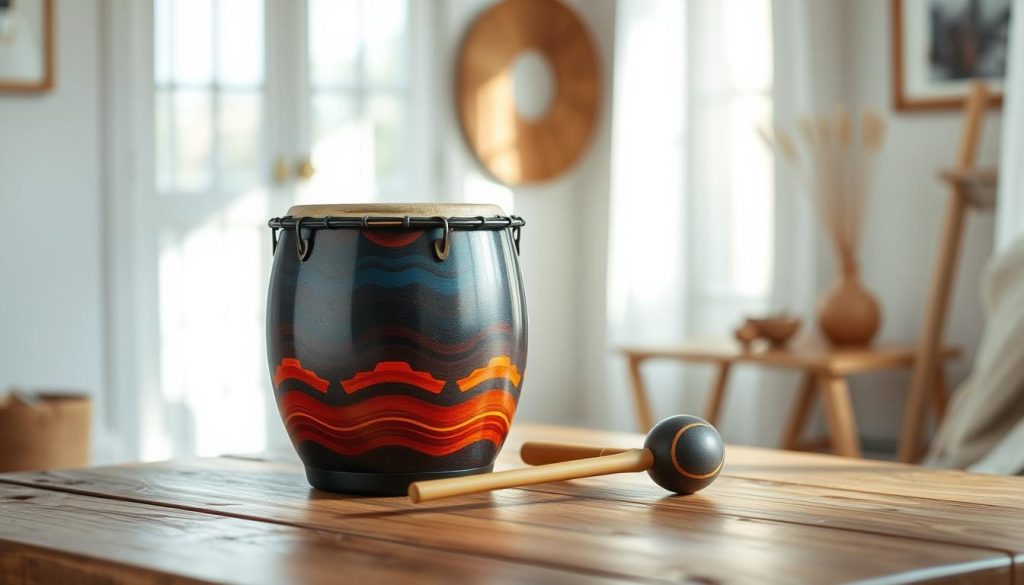
The tongue drum is a musical instrument with soothing sounds. It deserves careful consideration before purchase so you can find the model suited to your playing.
This guide presents the essential criteria: the number of tongues, size, frequency, and available notes. As an enthusiast who owns around ten steel tongue drums, I share practical advice to help you avoid common beginner mistakes.
You will discover how different models affect melodies and improvisation. We will also discuss budget, scales, and the essential accessories for getting started properly.
Objective: to help you invest in a durable instrument suited to your needs, whether you want to learn well-known songs or compose your own tunes.
How to choose your tongue drum: define your needs
Start by clarifying how you intend to play: relaxation, improvisation, or precise performance.
Defining how you will use the instrument is essential. An instrument intended for meditation may favor a simple scale and lower frequencies. A player who reads sheet music will need a model with more notes.
Also consider portability. If you play while traveling, choose a lightweight format. For home use, resonance takes priority.
The quality of the steel affects durability and tonal color. The number of tongues, size, and tuning determine versatility.
To avoid an unsuitable purchase, list your expectations before reviewing the available options. Consult a detailed guide if you are hesitating between intuitive playing and performing written music.
| Criterion | Impact | Advice |
|---|---|---|
| Use | Determines the scale and number of notes | Specify: meditation, improvisation, or sheet music |
| Size and portability | Resonance or mobility | Choose a small model for travel and a large one for depth |
| Material (steel) | Durability and timbre | Choose high-quality workmanship |
| Number of tongues | Melodic complexity | More tongues mean more options |
How the number of notes affects your playing style
An instrument’s range of notes defines its personality and your musical possibilities. A maker with 30 years of experience, like those at Hluru, will tell you that the number of notes affects emotional depth and versatility.
Intuitive playing or performing sheet music
For intuitive playing, 8 to 10 notes are often enough. These models allow people to create an atmosphere in seconds without reading sheet music.
By contrast, faithfully performing a song may require more resources. For example, playing “The Sound of Silence” requires a 15-note instrument to reproduce the original melody.
Complexity according to the number of tongues
More tongues mean more options: 15 notes let you separate harmony and melody, as on a miniature piano or handpan. This complexity increases both the price and manufacturing time.
- 6 to 8 notes: simple and suitable for beginners.
- 8 to 10 notes: ideal for instant improvisation.
- 15 notes: for playing complex songs and working from sheet music.
To choose the right model, assess your level and your goals over the coming years. For a broader comparison between instrument families, read a comparison article or a buying guide.
Choosing the ideal size for your instrument
The diameter and volume of the body define a model’s sound signature. They affect note clarity, sustain, and ease of transport.
Portability and acoustic resonance
A diameter of 30 centimeters offers an excellent balance between portability and deep resonance. This size lets you play rich melodies without being too bulky.
- Under 2 kg: ideal for traveling musicians who want to carry their instrument in a backpack.
- A larger body allows waves to develop and produces an ethereal, bright sound.
- Small models can create interference if the space between the tongues is too narrow.
- 33 to 38 cm: recommended for composers seeking exceptional sonic depth.
- Small or large: a small model favors fast melodies, while a large one emphasizes bass and sustain.
“Size shapes the instrument’s sonic personality—adapt it to your playing and travel needs.”
Choosing the right size ensures that the tongue drum produces clear notes and sustain suited to your scale and musical practice. Consider the balance between mobility and sound quality before buying your steel tongue drum.
Understanding the importance of materials and workmanship
The quality of the metal and heat treatment directly affects tuning stability and tonal color.
A steel-titanium alloy offers excellent corrosion resistance and produces a warm sound with long sustain. It is a wise choice for a durable instrument.
High-temperature annealing, used by some manufacturers such as Hluru, reduces internal stress. The result is stable tuning over several years and a more even response across the notes.
Standard carbon steel can produce an undesirable metallic noise that muddles the purity of the note. In humid climates, choose nitrided steel, which resists oxidation more effectively.
Electroplating provides a protective finish while allowing the shell to vibrate freely. Good workmanship ensures that your model stays in tune and delivers consistent sound options.
- Choose a well-machined model for lasting tuning stability.
- Beginners gain confidence from a consistent sound response.
- The material shapes the tonal color and your musical possibilities.
To learn more, consult this complete tongue drum guide.
Frequency and tuning: 432 Hz or 440 Hz
A difference of just a few hertz changes the balance between musical precision and inner sensation. This choice affects the instrument’s compatibility with other ensembles and the relaxation experience.
The 440 Hz standard for Western music
440 Hz is the reference frequency. It makes group playing and tuning with a piano or other instruments easier.
For group sessions and sheet music, choose this reference. It ensures consistency across notes and scales.
The benefits of 432 Hz for relaxation
432 Hz, known as Verdi tuning, is often chosen for meditation and yoga.
Many people report a calming sensation, although scientific evidence remains limited.
Warning: do not combine instruments tuned to 440 Hz and 432 Hz, as the dissonance can make listening unpleasant.
| Criterion | 440 Hz | 432 Hz |
|---|---|---|
| Main use | Group playing, sheet music | Meditation, yoga, sound healing |
| Availability | Very common | Rarer and often more expensive |
| Compatibility | High compatibility with other instruments | Low compatibility with 440 Hz instruments |
| Feel | Precise and standard | Gentle and grounded |
If relaxation is your priority, explore models tuned to 432 Hz. To stay aligned with Western music, choose 440 Hz. To learn more about the available options, consult this complete guide.
Essential accessories for getting started
A suitable set of accessories makes learning the notes easier and protects your instrument.
Mallets are the classic accessory. They provide precision and control when striking each tongue without damaging the surface.
Note stickers help beginners identify the corresponding notes quickly. They speed up sheet music reading and scale memorization.
- Carrying case: protects the instrument during travel around the world and makes it easier to carry.
- Silicone finger protectors: allow you to play by hand and obtain a muted sound while remaining comfortable.
- Booklet or sheet music in English: essential for learning the basics and progressing through exercises.
You do not need to choose a model based on its accessories. Most are sold separately. To save time, look at beginner kits, which often include mallets, stickers, and a carrying case.
Investing in good accessories improves playing comfort, tuning stability, and the longevity of your percussion instrument.
How much to budget for a quality instrument
Setting a clear budget prevents impulse purchases and guides you toward the best instrument for your preferences.
Prices vary widely: small models can be found for €50, while professional instruments cost more than €1,000. A realistic middle ground is between €100 and €200 for a mid-range instrument.
For a first purchase, do not spend more than €500 if you are still unsure. This helps you avoid excessive expense before confirming your commitment to playing.
Fifteen-note models often cost more, but they offer useful versatility for playing complex songs and working with varied scales.
- Price: from €50 to more than €1,000, depending on quality.
- €100 to €200: good value for beginners.
- Do not spend more than €500 on a first instrument.
Practical advice: define your expectations (meditation, improvisation, or sheet music), then compare the available options. For an initial point of reference, consult this beginner’s guide before making your choice.
Conclusion: making the best choice for your playing
In summary, the ideal instrument strikes a balance between your preferences and practical constraints.
This guide gives you the keys to choosing a tongue drum suited to meditation, yoga, or practicing scales.
Consider the number of notes, the size, and your budget. Choose a model that leaves room for progress over years of playing.
The Instruments du Monde store remains a trusted source for varied, reliable instruments from around the world.
Trust your instincts. Take the plunge and transform your moments of relaxation into genuine musical journeys.