
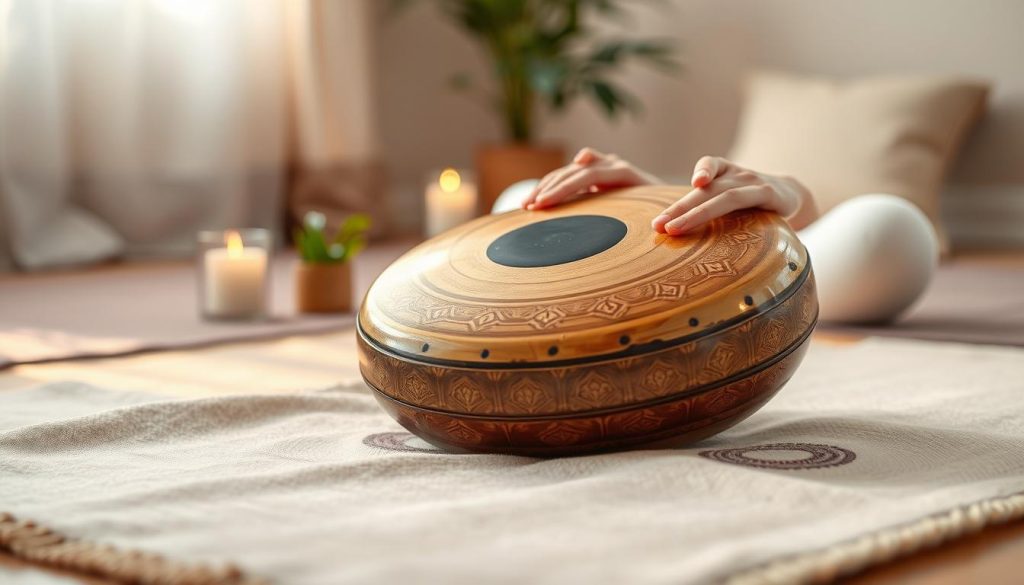
For more than five years, I have practiced meditation and yoga with my instrument to calm my mind after intense days.
This guide shows you how to transform your daily sessions into genuine moments of inner peace. The tongue drum is an accessible solution. It can be played without complex sheet music, making it easier to achieve a sense of calm.
You will find advice on preparing your drum, making the most of every session, and incorporating the tank drum into your yoga routine. Simple sounds encourage a quick connection between body and mind.
Each note releases harmonious tones designed to relieve the tensions of modern life. The approach is practical: clear steps, easy movements, and suggestions for short, effective sessions.
This first part of the article lays the foundations. It prepares the reader for the practical steps that follow.
Why choose the tongue drum for meditation and relaxation
Accessible and surprisingly rich, the steel tongue drum stands out for its steel construction and pure tone. It produces sounds that naturally envelop the listener.
Accessible to beginners, this instrument does not require complex knowledge of music theory. It lets you immediately produce pleasant melodies, encouraging regular practice.
Its versatility is an advantage: it is equally well suited to dynamic moments and quiet ones. Instruments of this kind are now widespread around the world, demonstrating their effectiveness.
- Robust steel construction and easy portability.
- Intuitive playing, with no sheet music required.
- Rich resonance that supports concentration.
| Criterion | Advantage | Ideal for |
|---|---|---|
| Construction | Durable steel, stable sound | Home use and performances |
| Accessibility | Immediate ease of use | Beginners and regular practitioners |
| Sound | Harmonious notes, long resonance | Concentration and wellness sessions |
If you would like to try this instrument in a guided setting, discover how to begin a session and experience its effects.
The benefits of music therapy for body and mind
Music therapy has measurable effects on the body and mind that can be noticed from the very first sessions. It combines sounds, rhythm, and vibrations to reduce tension and improve mental clarity.
Stress reduction
According to Emmanuel Bigand, a lecturer and researcher at the Institut universitaire de France, regularly practicing music reduces stress and promotes neuronal recovery.
Using a steel tongue drum during your sessions produces stable frequencies. These frequencies calm breathing and reduce muscle tension.
Development of cognitive abilities
Music therapy stimulates attention and memory. Playing simple instruments increases brain plasticity.
Tongue drums produce a harmonious sound that facilitates concentration. Their vibrations also help release accumulated tension.
| Effect | Evidence | Practical benefit |
|---|---|---|
| Stress reduction | Emmanuel Bigand, clinical research | Slower breathing, reduced anxiety |
| Cognitive abilities | Studies on plasticity | Better concentration and memory |
| Overall well-being | Music-therapy observations | Balance between body and mind |
Preparing your instrument for a relaxation session
Before each session, prepare your instrument and your space so that you can quickly reach a calm state.
Wear loose clothing and make yourself comfortable. Sitting cross-legged allows you to position the tank between your legs. If the instrument has rubber feet, place it on a hard surface to optimize its resonance.
Daily practice: a 10-minute session each day provides more benefits than one long weekly session. This consistency helps you maintain a meditative state over time and reduces stress.
Focus on your breathing before you begin playing. Adopting good striking techniques turns the tank drum into a powerful mindfulness tool. Practice light, even strikes to obtain a clear tone.
By devoting time to the instrument, you create an environment conducive to practice. This simple preparation improves the quality of your sessions and strengthens their long-term benefits.
Understanding the importance of the pentatonic scale
With only five degrees, the pentatonic scale avoids dissonance and makes sound exploration easier.
This simplicity helps beginners improvise without fear. The notes remain harmonious regardless of their order.
Why choose harmonious scales
Fewer notes, greater confidence: the pentatonic scale contains 5 notes, compared with 7 in the diatonic scale. This makes improvisation intuitive.
“The pentatonic scale ensures that every sequence sounds right, even without sheet music.”
- Easy identification thanks to stickers showing the notes on the instrument.
- Pretuned models provide a stable sound suited to your sessions.
- Understanding the different keys lets you adjust the tank and produce pleasant melodies.
| Strength | Explanation | Practical impact |
|---|---|---|
| Less dissonance | 5 notes designed to harmonize with one another | Error-free improvisation |
| Ease of learning | Reduced tonal range | Rapid progress |
| Accessibility | Pretuned models and stickers on the tongues | Smooth, peaceful sessions |
To explore the differences from other melodic instruments in greater depth, read a comparison devoted to the differences between the handpan and the tongue drum.
Adapting your tongue drum for smooth practice
A simple visual setup is all you need to play without hesitation.
Turning a diatonic model into a pentatonic one is very simple: ignore the tongues numbered 4 and 7 to obtain a scale without dissonance.
To adapt your instrument, use tongue stickers or red stickers to mark the notes you should avoid.
By visually marking the areas that should not be struck, you reduce mistakes and remain focused during the session.
- Mark tongues 4 and 7 with visible stickers.
- Practice slowly at first to become familiar with the new setup.
- This method makes practice easier and every session more accessible.
Learning to play the tongue drum requires patience, but this adaptation turns your instrument into a reliable companion.
By positioning your stickers correctly, you will soon be able to play the tongue drum with ease, with every note contributing to the overall harmony.
Playing techniques for entering a meditative state
Simple playing techniques transform your sessions into moments of concentration and calm. Begin by choosing a playing method suited to your goal: presence or sound exploration. Your movements directly influence the quality of the tones and vibrations.
Using mallets
Mallets produce clear strikes and long resonance. They amplify the notes and let you mark the rhythm effortlessly.
Use light, centered strikes to obtain full sounds. Vary the pressure to alter the timbre.
Playing with your fingers
Playing with your fingers creates an intimate connection with the instrument. It produces gentler sounds and subtle vibrations.
Use slow, regular movements. This approach helps calm your breathing and deepen the meditative state.
Repeating mantras
Combine simple phrases or repeated syllables with sequences of notes. Repetition steadies your attention and creates a soothing sound structure.
- Choose a model tuned to a pentatonic scale to avoid dissonance.
- Alternate between mallets and fingers depending on the intensity you want.
- Experiment with different pressures on the tongues to vary the sounds.
In practice, mastering these techniques lets you play the tongue drum fluidly. To go further and deepen your practice, read everything you need to know.
Choosing the ideal model for your needs
A carefully chosen instrument transforms every session into a rich and lasting experience.
Recommended size: to begin your musical journey on the right foot, choose a steel tongue drum measuring at least 33 centimeters. This size provides deep resonance and more enveloping tones.
Build quality directly affects the richness of the notes and tuning stability. A well-made model retains its tone for longer and requires fewer adjustments.
This guide helps you compare different models by considering the number of notes, the size of the tank, and the finish. Choosing a good drum makes it easier to achieve a calm state because the instrument responds more effectively to your intentions.
- Check tuning stability to ensure lasting benefits.
- A large number of notes offers variety; fewer notes provide greater intuitiveness.
- Stickers help beginners visualize the notes and speed up learning.
Investing in quality is a lasting choice: a higher-quality instrument ensures consistently immersive sound sessions. To learn more, read our complete guide and compare the available models.
Differences between melodic percussion instruments
Instruments in this family share the same musical purpose, but their designs give them very distinct identities.
Origin and design: the Hang was invented in Switzerland in 2000 by Felix Rohner and Sabina Schärer. It consists of two welded metal shells, giving it a soft, airy timbre.
The handpan is an artisanal evolution of the Hang. Depressions are hammered into its surface to form the notes. Each craftsperson uses their own tuning techniques, producing unique models around the world.
Practical distinctions between the Hang and the handpan
Unlike these models, the steel tongue drum uses cut tongues to create its notes. This structural choice gives it a more percussive attack and tones that are easier to control.
- Playing: the Hang is played only by hand, allowing refined finger techniques.
- Accessibility: the steel tongue drum can be played with mallets or fingers, making it easier to learn.
- Sounds: from the ethereal sound of the Hang to the more percussive sounds of tongue drums, each musical instrument offers its own melodies.
| Feature | Hang and handpan | Steel tongue drum |
|---|---|---|
| Construction | Two welded shells, hammered depressions | Tongues cut into a single shell |
| Playing techniques | Fingers only, highly tactile playing | Fingers or mallets, versatile playing |
| Sound | Ethereal tones, long resonance | More percussive sounds, distinct attack |
| Variations | Local craftspeople, tuning variations | Pretuned and handcrafted models |
By comparing these models, it becomes clear why many people choose the steel tongue drum for its versatility and accessibility. For a more detailed technical comparison, read an article about the differences between the Hang and the tongue drum, or discover basic handpan rhythms in rhythms for beginners.
Tips for maintaining your instrument and extending its life
A few daily steps are enough to preserve the sound quality and appearance of your steel instrument.
Always wipe your instrument after every session with a soft, dry microfiber cloth. This reduces moisture on the surface and prevents oxidation.
Store the tongue drum in its carrying case when it is not in use. A dry location protected from temperature fluctuations safeguards the tuning of every scale.
- Regularly check the condition of the stickers so you can play without mistakes.
- Avoid prolonged exposure to sunlight and extreme temperatures.
- Gently clean the striking areas to preserve sound quality.
Learning to play the tongue drum also means mastering maintenance techniques. Regular care extends the life of your model and enhances the benefits of your practice.
| Action | Frequency | Impact |
|---|---|---|
| Wipe with a microfiber cloth | After every session | Preserves the finish and prevents oxidation |
| Store in a dry place | At all times | Maintains tuning and extends service life |
| Check the stickers | Weekly | Ensures smooth, error-free practice |
| Protect from heat | Whenever the seasons change | Preserves note quality and the steel structure |
Conclusion
Ultimately, incorporating this instrument into your routine offers a direct path toward a lasting state of calm.
Incorporating the tongue drum into your daily routine makes it easier to reduce stress and improve your quality of life. Regular practice provides measurable benefits and genuine support for yoga or any pursuit of well-being.
With the advice in this article, you have everything you need to begin with confidence. Explore different scales and playing styles to enrich your musical journey.
To learn more, discover the Sonodrum collection and its resources. Every moment spent with your instrument becomes an opportunity to cultivate inner peace.