
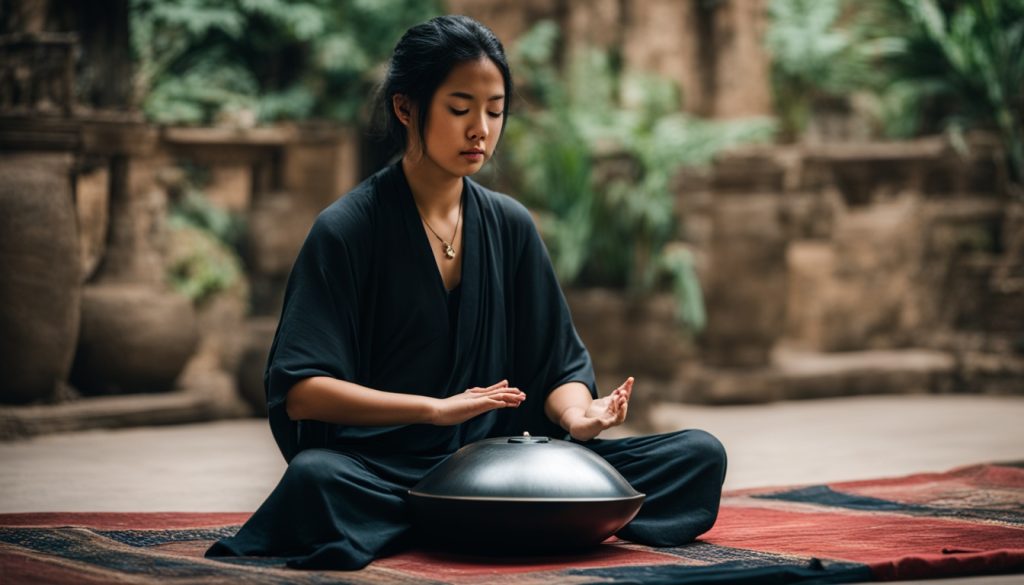
The time needed to learn the handpan varies from person to person. This musical instrument was created in 2009 by Felix Rohner and Sabina Schärer. It has 7 to 8 harmonic notes around the “ding” note located in the center.
Beginners can start playing simple melodies after a few hours. However, learning advanced techniques can take months or years. Several factors affect the learning process, including the methods used and the learner’s commitment.
Resources such as MasterTheHandpan offer online courses. They allow anyone to learn to play the handpan, even without musical experience.
Introduction to the handpan
The handpan is an instrument that has won the hearts of many music enthusiasts. It was created in the early 2000s by Felix Rohner and Sabina Schärer in Bern, Switzerland. Since then, more than 100 craftspeople around the world have developed their own versions of the handpan.
Origin and history of the instrument
The first handpan was created in 2000. In 2013, Rohner and Schärer stopped producing the Hang to preserve its unique character. The term “handpan” now refers to the various versions created by other makers. This popularity has attracted yoga instructors and therapists, who appreciate its ability to create relaxing music.
Unique features of the handpan
The handpan has an ovoid shape, measures 21 inches wide by 9.5 inches high, and weighs 8.5 pounds. It is handmade from heat-treated steel. Each instrument has a unique sound thanks to a variety of notes such as F3, A3, C4, and many others.
Handpan music is often played at intimate concerts. It creates an atmosphere conducive to relaxation and meditation.
| Dimensions | Weight | Materials |
|---|---|---|
| 21 inches (33 cm) wide, 9.5 inches (24 cm) high | 8.5 pounds (3.85 kg) | Heat-treated steel |
Why is the handpan easy to learn?
The handpan is ideal for anyone who wants to get started with music. It is easy to learn, even without prior musical knowledge. This intuitive instrument encourages everyone to explore and freely discover new sounds.
Accessible to beginners
Beginners appreciate the handpan for its simplicity. It is easy to create melodies, even for people who have never played an instrument. The handpan’s diatonic structure makes it accessible to learn. Taking part in workshops and training sessions helps beginners build confidence.
An intuitive instrument and spontaneous musicality
The handpan encourages spontaneous musicality. It can be played without following complex sheet music. Its intuitive nature stimulates creativity. Musicians can improve their sense of rhythm by playing alone or in a group.
The beauty of the handpan lies in its ability to bring people together around a shared passion. It therefore helps create genuine connections between individuals.
How long it takes to learn the handpan
Learning the handpan takes time, but the duration varies from person to person. Some beginners play fast melodies after just a few hours. This is because the instrument comes pre-tuned, allowing people to start without musical knowledge.
Learning melodies quickly
Many people manage to play simple melodies in fewer than 20 hours. This makes the handpan highly appealing to those who want to unleash their creativity effortlessly. Online courses allow everyone to learn at their own pace and gain confidence.
Mastering advanced techniques
Advanced techniques, such as variations in striking, take more time. Some people may need months or years to master them. Workshops and music retreats speed up this process by providing professional guidance and opportunities to practice regularly.
Different ways to learn the handpan
Learning the handpan is flexible and can be approached in several ways. MasterTheHandpan’s online courses are suitable for everyone, from beginners to advanced musicians. Starting at €1 per day, these easy-to-follow videos help learners progress quickly. New members receive more than 100 free lessons to discover the instrument.
Online courses
Online courses are perfect for people who want to learn at their own pace. They offer a 100% money-back guarantee as well as unlimited access. Lessons are taught by experts such as David Charrier and Manu Delago, ensuring high-quality instruction.
Hands-on workshops and music retreats
Hands-on workshops and music retreats provide an enriching experience. They offer opportunities to connect with professionals and other enthusiasts. These experiences encourage knowledge-sharing and skill development while strengthening personal connections.