
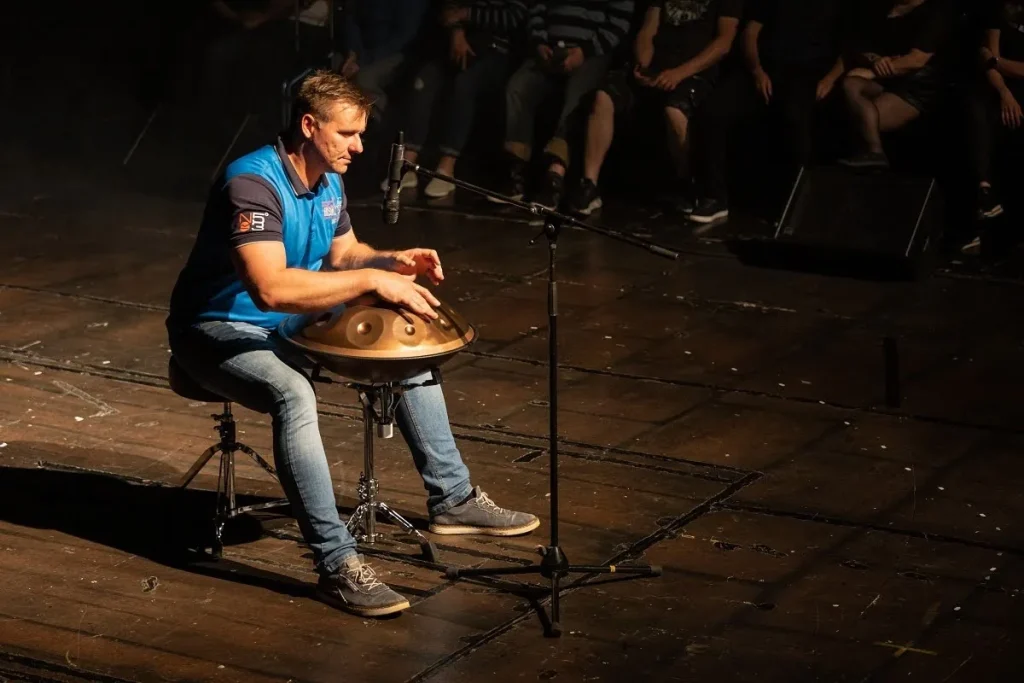
The handpan is a melodic instrument that captivates listeners with its enchanting sounds. Accessible from an early age, it offers a fun introduction to music.
Learning to play promotes coordination and sensory development. Children enjoy its tactile simplicity, while parents discover an opportunity to bond with them.
Emmanuelle, the mother of two young musicians, says: “It has become our weekend ritual. Their progress is clear, and laughter is guaranteed!”
With suitable methods such as those offered by Sonodrum, even beginners can quickly create melodies. Colors help them memorize the notes, making the experience both educational and entertaining.
Why introduce your children to the handpan?
From their first encounter, children are fascinated by this instrument’s harmonious vibrations. With its enchanting sounds, the handpan turns learning into a sensory adventure.
An intuitive and accessible instrument
Its diatonic tuning eliminates wrong notes and delivers a rewarding experience from the very first strikes. Ideal for young musicians, the steel tongue drum suits every skill level without requiring advanced knowledge of music theory.
Musical and developmental benefits
Playing stimulates coordination between the right and left hands and improves concentration. “The soothing sounds even help with stress management,” says a mother whose child uses the instrument during anxiety attacks.
Guided improvisation stimulates creativity, while rhythmic patterns teach the fundamentals of music. It is an educational game that also prepares children for other instruments, as shown by this comparison with the xylophone.
Choosing the right handpan for your child
Finding the ideal instrument depends on several technical and ergonomic criteria. A model with 9 notes and a central tone field provides an excellent introduction, as experts confirm.
Selection criteria: size, scale, and material
Choose a major scale for cheerful tones. The material affects the sound: nitrided steel is more durable, while stainless steel produces a crystalline tone.
For young musicians, a diameter of 50 to 55 cm provides an optimal reach. Remember to check the weight as well, especially for children under eight.
Models suited to small hands
Some manufacturers offer rounded edges to prevent injuries. The F minor Akebono scale is perfect for gentle melodies.
| Criterion | Recommendation |
|---|---|
| Number of notes | 9, including 1 central note |
| Material | Nitrided steel (durability) or stainless steel (clear sound) |
| Weight | 2 kg maximum for ages 5 to 7 |
A detailed buying guide makes the choice easier. Some workshops even offer custom tuning to suit each child.
Handpan fundamentals: taking your first steps as a family
Exploring the fundamentals of the handpan opens up a musical world that everyone can enjoy. With a playful approach, even the youngest children can create melodies after only a few sessions.
The ideal playing posture
Sit cross-legged or on a low stool, with the instrument resting on your lap. Your fingers should gently brush the notes to produce a pure sound.
A mirror can help correct hand position. “Children love watching themselves play—it is like a dance!” notes one teacher.
Discovering notes and simple rhythms
Begin by striking the central note, then explore the others in a circle. The technique of using ghost notes (imaginary strikes) makes memorization easier.
- Warm up the wrists with gentle rotations (5 min).
- Use a metronome for rhythmic exercises.
- Create stories with the notes (e.g., A is a bird).
Adding colors to the notes turns learning into a game. Regular practice enables rapid progress.
Playful exercises for learning while having fun
Turning learning into a game makes music even more magical. These creative activities make every session a moment of shared enjoyment.
Rhythm games to play together
The mirror game develops active listening. The child repeats your musical phrases like an echo, working on memory and rhythms.
Organize a friendly battle with a points system. “We take turns playing patterns and score each other’s accuracy—it has become our Sunday championship!” says Julien, Léa’s father.
- Add accessories such as soft mallets to vary the sound textures
- Include body percussion (clapping and thigh tapping)
- Use a bouncing ball to mark the tempo
Creating melodies like stories
The Storypan method brings notes to life. Associate each tone with a character or element (D = sunshine, G = rain).
Compose soundscapes based on themes such as the sea or outer space. These melodies with a narrative stimulate the imagination while teaching intervals.
“Our story about the little dragon lasted three months. Every week, we added a new note-character!”
Record their progress with dedicated apps. Weekly challenges accompanied by symbolic rewards (stickers or the choice of the next story) maintain motivation.
With these exercises, every session becomes an adventure during which the hand discovers its power to create emotions.
Making the handpan part of your family routine
The handpan fits naturally into everyday life, creating unique moments. This instrument integrates perfectly into daily routines and offers far more than a simple musical activity.
Good times to play together
In the morning, a gentle melody can replace the alarm clock. It is a soothing way to begin the day. In the evening, turn bedtime into a musical ritual.
Use weekends to organize longer sessions. Dedicated time strengthens bonds while stimulating creativity. Vacations are ideal for creating an audio journal of family memories.
- Guided improvisation after school to unwind
- Monthly mini-concerts to celebrate progress
- Community challenges to stay motivated
Turning practice into a joyful ritual
Combine the instrument with everyday tasks. Fold laundry in rhythm or use a note as a signal during transitions. These little moments make learning fun.
Involve grandparents in an intergenerational collaboration. “It has become a secret language between my grandchildren and me,” says Claire, 62.
“Every Saturday, we improvise a different melody. It is our way of summarizing the week through music.”
Family experiences and testimonials
Music creates unique bonds. Through these testimonials, discover how the handpan transforms the daily lives of many players and their loved ones.
The handpan as a bonding tool
For the Durand family, this instrument has become a secret language. “Our three children invent melodies together. It is our new way of communicating,” says their mother.
A professional musician and father discovered a new passion: teaching methods tailored to young children. His family workshop now attracts other beginners.
- Noticeable improvement in concentration for a child with ADHD
- Creation of a keepsake album with monthly recordings
- Participation in local charity concerts
Progress and shared pride
93% of users observe visible progress within the first month. Lucas, age 8, proudly shows off his drawings of colorful notes.
The growing community shares its achievements. Videos comparing results before and after six months reveal spectacular improvements in technique.
| Benefit | Testimonial |
|---|---|
| Perseverance | “My son now finishes his homework without giving up” |
| Confidence | “My daughter now dares to play in front of her classmates” |
| Creativity | “We compose our own songs together” |
“Every note is a victory. Seeing my child flourish this way is magical.”
Resources for going further
The world of the handpan offers a wide variety of resources for developing your playing. Whether you are looking for online lessons or opportunities to connect with fellow enthusiasts, these tools accelerate progress.
Digital learning platforms
Several academies offer programs designed for young musicians. Sonodrum’s unlimited pass includes masterclasses and live workshops.
- Comparison: Handpan Dojo (tutorials on uncommon scales) vs. Pantam School (progressive method)
- Free discovery kit with five lessons on most platforms
- Monthly webinars with experts such as David Charrier
Steel tongue drums also have dedicated content. Some teachers even offer mentorship programs between families.
Parent support networks
Online communities are full of practical tips. Specialized Facebook groups share guides and personal experiences.
“Our local group organizes seasonal challenges. The children love showing their progress!”
- Directory of certified teachers by region
- Sharing sheet music adapted for the tongue drum
- Virtual meetups for exchanging techniques
These resources turn learning into a collective adventure. Friendly encouragement creates natural motivation among young musicians.
Conclusion: your family musical adventure begins here
The magic of the handpan turns every session into a treasured memory. This unique instrument strengthens bonds while stimulating creativity, combining enjoyment with progress.
Enjoy a free 14-day trial and download our PDF of playful exercises. In-person workshops and instrument rentals are available to help you get started easily.
As David Charrier says: “The handpan is not just an instrument; it is an adventure that brings generations together.” Get started and create your own melodies today!