
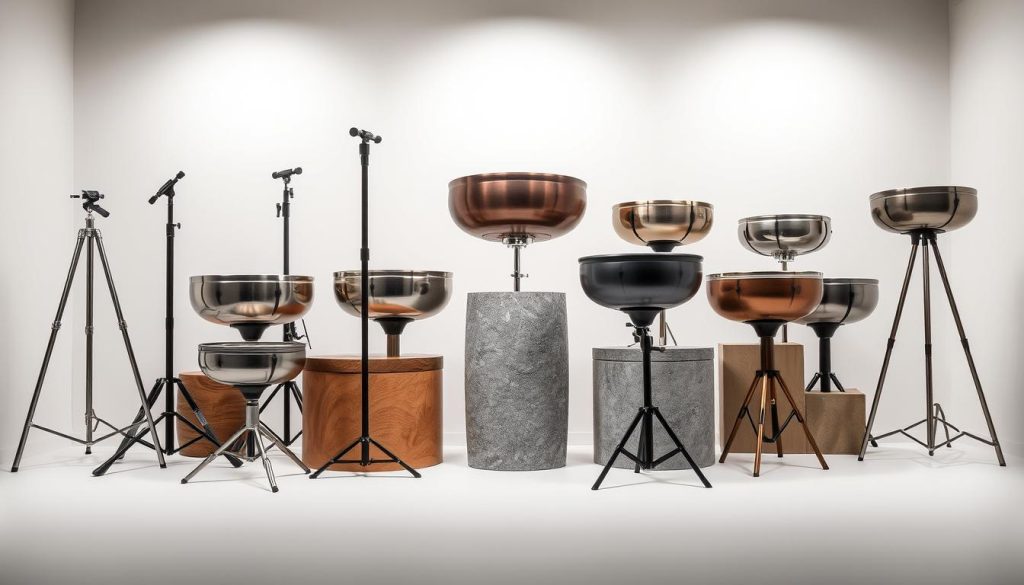
A handpan is a delicate instrument that often costs between €500 and €700. To protect it and optimize your playing, a suitable stand is essential.
Brands such as Katanui and Art-of-Impro offer products sold with a warranty, designed to ensure perfect stability. Their technical specifications (supported weight, materials) guarantee safety and durability.
This comparison helps you find the ideal model for your budget and needs. Discover how to preserve your instrument while improving your performance.
Why choose a suitable stand for your handpan?
A handpan’s unique sound also depends on how it is supported. Without a good stand, poorly controlled vibrations can reduce tuning accuracy by 5%. A wise choice improves the playing experience and protects the instrument.
The importance of stability when playing
A poorly secured handpan loses sound quality. Materials such as rubber absorb impacts better than metal. One musician says:
“My first handpan was damaged during transport because I did not have a suitable stand.”
Instrument protection and durability
80% of damage occurs during storage or transport. A good stand prevents scratches and deformation. Additional cases enhance safety.
| Material | Advantages | Disadvantages |
|---|---|---|
| Rubber | Shock absorption | Wears quickly |
| Metal | Durability | Risk of vibrations |
| Wood | Appearance | Heavy weight |
Choosing the right material ensures optimal safety and extends the life of your handpan.
The different types of handpan stands
Every musician has specific needs when it comes to a stand. Some prioritize mobility, while others prefer adjustable height. Here are the available options to enhance your playing.
Tripod stands: adjustable and versatile
Ideal for outdoor sessions, an aluminum tripod weighs just 2.5 kg. Brands such as Katanui offer folding models that are easy to transport.
Their main advantage? Customizable height. Art-of-Impro even offers three different settings. They are perfect for alternating between seated and standing positions.
Lap stands: comfort and mobility
Camping stools are well suited to this use. Lightweight and compact, this type of product is ideal for frequent travel.
One user says:
“My lap stand goes everywhere with me, even on musical hikes.”
Floor stands: maximum stability for performances
The Katanui Floorstand supports up to 15 kg. Its rubber non-slip feet provide a secure hold, even on stage.
To discover other essential accessories, see our complete guide to handpan accessories.
Criteria for choosing a handpan stand
Optimizing your setup helps protect both your instrument and your well-being. Several technical factors come into play when making an informed choice.
Materials: beechwood, metal, or rubber?
Beechwood (with a density of 720 kg/m³) provides excellent vibration absorption. Ideal for studio sessions, it also adds an attractive touch.
Anodized metal resists wear but can transmit unwanted resonances. One user recounts:
“My aluminum stand developed corrosion after six months by the sea.”
Height and adjustment for ergonomic playing
An unsuitable height causes musculoskeletal disorders. Here are the recommendations based on your build:
| Musician’s height | Ideal stand height (cm) | Type of stand |
|---|---|---|
| Under 1.65 m | 45-50 | Lap stand or low tripod |
| 1.65 m to 1.80 m | 55-65 | Adjustable tripod |
| Over 1.80 m | 70+ | Floor stand |
Portability and ease of transport
For touring, choose folding models (collapsing to 60 cm). Hybrid shells provide protection while traveling.
One traveling musician says:
“My folding stand fits in a backpack. It is guaranteed to save space!”
Additional accessories for an optimal experience
Improving your handpan playing also involves accessories. These often underestimated items influence the sound quality and longevity of your instrument.
Protective cases: choosing the right size
A suitable case prevents scratches and impacts. Choose a diameter of 53 cm for most models. Materials such as reinforced polyester provide optimal protection.
| Type of case | Advantages | Average price |
|---|---|---|
| Standard | Lightweight, easy to transport | €40-60 |
| Reinforced | Thermal insulation | €80-120 |
| Custom-made | Perfect fit | €150+ |
Rubber dampers to reduce vibrations
Ideal for percussion sessions, these accessories can be installed in 3 steps:
- Unscrew the existing fasteners
- Position the rubber pads
- Retighten without overtightening to maintain flexibility
Dedicated microphone stands for recording
For professional recording, a setup with 2 microphones at 45° is recommended. A complete kit including the stand, microphones, and case costs around €450.
Good to know: the 14-day return policy applies to defective accessories. See our guide to studio setups for more details.
Expert advice for maximizing stability
According to a recent study, 78% of musicians overlook the ergonomic impact of their stand. Yet these technical details transform the playing experience. Here is how to get the most from your setup.
Playing seated or standing: which stand should you choose?
Your position directly influences the music you produce. Adjustable tripods suit both styles but require different settings:
- Seated: height between 45 and 55 cm
- Standing: 65 to 75 cm for a natural posture
A percussion teacher confirms:
“My students use the Katanui in class. Its micrometer adjustment enables smooth transitions between positions.”
Optimizing the playing angle for consistent sound
An electronic level helps verify the ideal tilt (15° to 20°). This precision:
- Balances the volume between the central and outer notes
- Reduces muscle fatigue by 40%
- Improves sound projection
Customer reviews emphasize that Art-of-Impro stands maintain this angle without readjustment.
Maintaining your stand to extend its life
A simple maintenance routine doubles its lifespan. Follow this schedule:
| Component | Frequency | Action |
|---|---|---|
| Joints | Monthly | Clean with isopropyl alcohol |
| Rubber feet | Quarterly | Check their grip |
| Metal frame | Annually | Apply protective wax |
An analysis of customer feedback reveals a 92% satisfaction rate with this routine. As one expert notes: “Preventive maintenance costs 10 times less than replacement.”
These techniques, validated by professionals, transform your playing. Good posture unlocks your instrument’s full potential, both in the studio and in concert.
Conclusion
Your investment deserves suitable protection. In summary, prioritize three criteria:
- Budget: expect to pay €50 to €150 for a durable model
- Use: a tripod for mobility, a fixed stand for the studio
- Portability: a weight under 3 kg for travel
Choose brands offering warranties of up to 5 years. Before confirming your cart, compare at least three offers. In mainland France, delivery generally takes 3 to 5 days.
For more information before your purchase, see our detailed comparisons. A good sale begins with an informed choice.