
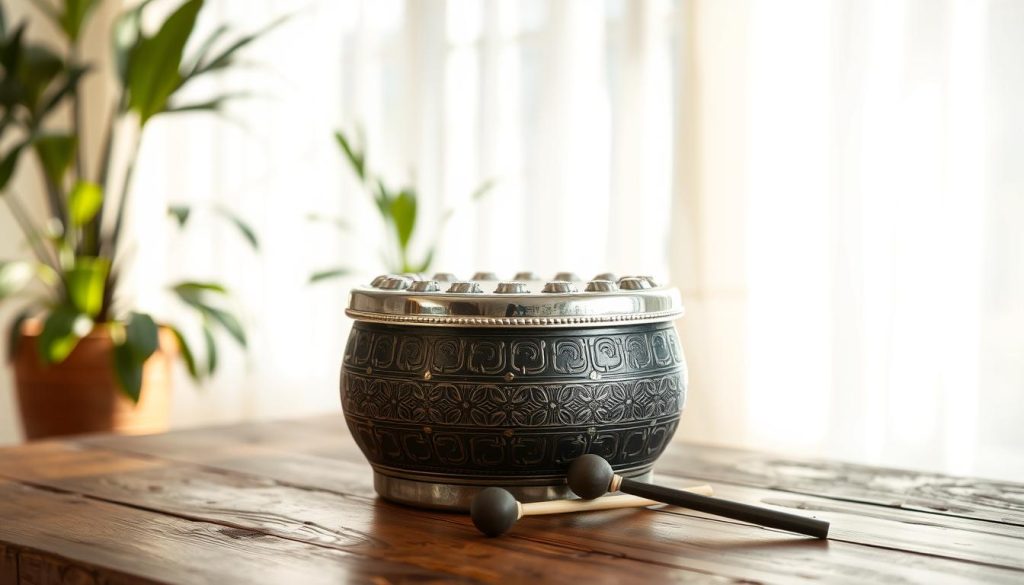
Choosing a simple, soothing instrument makes all the difference for a beginner. A steel tongue drum produces gentle sounds and notes that blend together easily. This instrument lets you play harmonious melodies without complex music theory.
For meditation, yoga, or relaxation, this musical object provides immediate satisfaction. Its diatonic scale encourages intuitive playing and the quick creation of rhythms. The price is often affordable, making it an accessible choice.
Watching a demonstration video helps you understand the sound quality and the instrument’s potential for music or meditation sessions. Unlike the piano, this instrument promises quick learning and pleasing results from the very first notes.
Understanding the tongue drum and its origins
This modern instrument has its roots in experiments with metal and the search for meditative sounds. It combines DIY craftsmanship and innovation while remaining accessible to enthusiasts.
History and evolution
In 2007, American Dennis Havlena formalized the modern version by cutting tongues into propane tanks. Before him, Jim Doble had already made the Whale Drum from gas cylinders in 1990.
These prototypes inspired more sophisticated models. Industrial production subsequently standardized the quality of the steel to ensure consistent resonance.
The idiophone family
This instrument belongs to the idiophone family: its sound comes directly from the vibration of its steel body. It is sometimes compared to the handpan, but differs through the visible cutouts in its upper shell.
- Names: its name has evolved over time: hank drum, zen drum, tongue.
- Construction: worked steel with cut blades or tongues.
- Use: easy to play and appreciated for meditation and light percussion.
Why choose a C major tongue drum?
For a beginner, a C major scale simplifies learning and makes it possible to play familiar tunes quickly.
The clear structure of the notes helps prevent wrong notes: each element is tuned in a logical order. This makes musical exploration safer and less intimidating.
A musician can follow a video tutorial and easily reproduce famous melodies, provided the instrument is properly tuned. The price is often accessible, making it a good investment for curious beginners.
Unlike more complex scales, this option offers bright, cheerful sounds without requiring advanced technique. However, it can still be helpful to compare other scales before deciding.
- Practical benefit: quick to learn.
- Musical benefit: a wide potential repertoire.
- Financial benefit: a reasonable budget for trying it out.
To explore the comparison between scales and choose the key suited to your project, read our guide to scales and keys.

The therapeutic and relaxing benefits of this instrument
The instrument’s subtle vibrations help slow your breathing and refocus your mind.
Regular practice reduces stress and anxiety through gentle sounds. The clear notes encourage slower breathing. This improves sleep quality and recovery after a busy day.
During a meditation session, simple scales make it easier to concentrate. Just a few minutes can be enough to enter a mindful state. For many practitioners, the effect is immediate.
Effects on stress and meditation
- Rapid stress reduction through soothing vibrations and sounds.
- Improved sleep when practice becomes regular.
- Effective accompaniment for yoga and breathing exercises.
- Choosing the right scale and notes lets you adjust the emotional effect.
Adding this instrument to a daily routine helps release tension and cultivate better mental well-being.
How the tongues work technically and acoustically
Understanding how the tongues vibrate helps you control the volume and tone color more effectively. The instrument works through the vibration of each steel tongue: its size determines the pitch of the note.
When struck, vibrations travel through the resonating chamber and reach approximately 70 to 80 decibels. The quality of the steel and the precision of the cutouts reduce interference between notes.
Playing with mallets produces clearer, more dynamic sounds. Playing with the fingers creates a gentler attack and more muted tones. Modern tuning techniques allow each tongue to be aligned for a consistent experience.
A good instrument offers a balance between its tones. It facilitates transitions between notes and makes it possible to perform complex melodies smoothly.
- Average volume: 70 to 80 dB when struck.
- Material: quality steel and precise cutouts ensure better acoustic quality.
- Playing methods: mallets for power, fingers for softness.
To learn more about manufacturing and quality standards, read our complete guide to this instrument.
Comparing major and minor scales
The choice of scale directly influences the emotional color of melodies. Understanding this difference helps shape your practice and the instrument’s sound.
The clarity of the major scale
The major scale offers a clear, bright sound. It makes it easier to create lively, dynamic melodies.
Its diatonic order ensures that almost every combination of notes sounds harmonious. For beginners, this reduces the risk of wrong notes and encourages exploration.
Expressing emotions
By contrast, the minor scale brings a more intimate and melancholic color.
It is ideal for contemplative pieces or accompanying a meditation session. Musicians will find it well suited to nuance and profound expression.
- Clarity: major = joy, minor = introspection.
- Learning: unlike a piano, a tongue drum is often limited to one scale, which simplifies practice.
- Creativity: understanding scales lets you fully explore your instrument’s musical possibilities.
The crucial role of the number of notes in your practice
The number of notes directly affects the color and range of your pieces.
An instrument with 8 to 11 notes offers an excellent compromise. It provides enough range for composing while remaining simple for a beginner.
A larger number of notes offers more harmonic options. However, it also increases the risk of interference between frequencies. Careful tuning then becomes essential.
“A suitable number of notes makes learning easier and stimulates creativity.”
Check the notation supplied by the manufacturer: some count the central note, while others do not. This difference can be surprising when making a purchase.
- Suitability for your level: a moderate number of notes causes less frustration.
- Sound quality: more notes require more extensive tuning work.
- Price: greater complexity often means a higher cost.
To learn more about manufacturing and choosing an instrument, read our complete guide or the handpan vs. tongue drum comparison.
Choosing the ideal frequency for your needs
The tuning frequency strongly influences how an instrument is perceived and used in group or therapeutic settings.
The debate between 440 and 432 hertz
440 Hz is the Western standard. This frequency makes group playing easier and avoids tuning problems with other instruments.
432 Hz is believed by some to have relaxing and meditative properties. Some practitioners feel that it produces a warmer effect that is closer to natural energy.
- To play with other musicians, choose 440 Hz.
- For individual use, yoga, or sound therapy, 432 Hz may be more suitable.
- Always check the stated frequency before purchasing.
| Frequency | Benefit | Recommended use | Effect on stress |
|---|---|---|---|
| 440 Hz | Standard compatibility | Groups, recording | Moderate |
| 432 Hz | Perceived as gentler | Meditation, yoga, therapy | Enhanced |
Consider your intended use and read our guide to scales and keys to make an informed choice.
Advice for beginners who want to learn music
Start with a suitable instrument to stay motivated. A properly sized model is easier to handle and lets you hear every note clearly from the first week.
The importance of diameter
A diameter of 20 to 25 cm is ideal for beginners. It makes the tongues easier to handle while retaining adequate resonance.
This choice reduces fatigue and helps you position your fingers or mallets accurately.
Essential accessories
Protect your purchase with a carrying case and suitable mallets. These items extend the instrument’s life and make it more comfortable to play.
A small kit consisting of a case, mallets, and a cleaning cloth is enough to get started with confidence.
Budget and quality
The quality of the steel ensures stable tuning over time. Do not choose solely on the basis of price: prioritize quality to avoid premature repairs.
- A reasonable budget is enough to get off to a good start.
- Begin with a limited number of notes.
- Patience and regular practice accelerate musical progress.
For detailed information, read our complete guide.
Differences between the tongue drum and the handpan
These two instruments have a similar silhouette, but their manufacturing methods are very different.
Manufacturing method: one—the steel tongue drum—is cut to form tongues, while the other is shaped through hammering and sinking. This distinction creates different timbres and harmonics.
Size and playing: the handpan is often larger and requires a more precise touch technique from the musician. The cut-tongue model remains accessible and intuitive for percussion practice.
Name and construction: the name reflects the construction: tongues produce the vibrations on the first instrument, while the second uses recessed areas for each note.
Price and investment: a handpan generally costs much more. For beginners, the steel tongue drum offers excellent value for money.
Unlike the piano, both instruments encourage an intuitive approach and make it possible to create melodies without studying music theory. For a detailed comparison, read about the differences between the handpan and tongue drum.
“The choice mainly depends on your budget and the level of technique you want to develop.”
- Accessible: cut-tongue model for beginners and relaxation.
- Advanced: handpan for expressive playing and subtle nuances.
- Practical advice: test the instrument before buying it, if possible.
Where to find and test your future instrument
Testing several models in a store remains the most reliable way to assess an instrument’s resonance and ergonomics.
Specialist stores let you try different scales and hear the notes under real-world conditions. Sales staff often provide useful advice for beginners. They can also explain the differences from a handpan and how these affect the price.
Before traveling, watching a video can provide a useful initial reference. An online demonstration offers a preview of the timbre but cannot replace trying the instrument in person.
It may be helpful to rent an instrument for a few days. This option lets you determine whether playing it suits your relaxation or meditation practice.
| Option | Benefit | Ideal for | Practical advice |
|---|---|---|---|
| Specialist store | Hands-on trial, advice | Beginners and serious buyers | Try several models |
| Online video | Quick sound reference | Preliminary research | Compare several sources |
| Rental | Extended trial | Potential regular use | Check its condition and tuning |
| Reviews and forums | User feedback | Comparing scales and prices | Prioritize detailed reviews |
In summary: combine an in-store trial with videos and online reviews to refine your choice. This will help you choose the instrument that truly meets your expectations.
Conclusion
Important: its design makes sound exploration and immediate creation easy, allowing you to progress without stress.
The tongue drum in C major remains an excellent entry point into making music. Its simplicity helps you stay motivated and quickly find moments of relaxation.
By comparing the different scales and frequencies, you will be better able to adapt the instrument to your relaxation or composition needs. Also consider the number of notes and manufacturing quality: these are indicators of longevity.
In summary, this instrument offers considerable creative freedom and a gentle approach to learning. With this advice, you are ready to begin your sound journey and explore its full potential.