
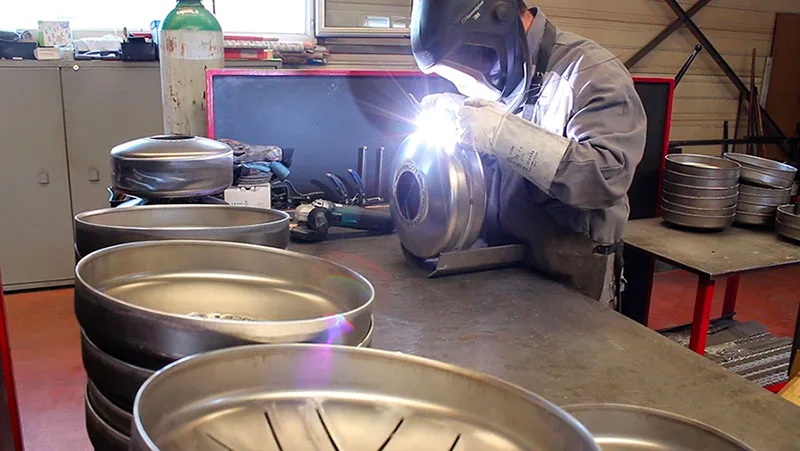
Building a unique instrument like a handpan requires careful attention to detail. This article guides you in choosing the right material thickness, which is essential for sound quality and strength.
Handpans are made from two assembled convex shells, generally measuring between 45 and 60 cm in diameter. Their quality largely depends on the choice of metal and its thickness.
Stainless steel, nitrided steel, and Ember steel are commonly used. Each option affects resonance and durability. Tuning remains a complex step that is directly linked to these criteria.
Discover the basics here for making your project a success by combining traditional techniques with modern innovations.
Introduction to the handpan and how it is made
The handpan, a fascinating instrument, captivates listeners with its mesmerizing sounds. Invented in Switzerland by PANArt in 2000, it quickly became a symbol of musical creativity. Its design is based on precise acoustic principles in which every detail matters.
What is a handpan?
This idiophone instrument produces melodic notes when its surfaces are struck. Made of two joined steel shells, it offers a rich harmonic range. The central Ding and the Tone Fields enable unique sound variations.
Compared with its predecessor, the Hang®, the handpan features developments in its design and tuning. Standard frequencies (440 Hz or 432 Hz) affect its resonance, a phenomenon explained by Helmholtz.
Why make your own handpan?
Making a handpan at home allows complete customization. You choose the materials, thickness, and tuning. It is also a rewarding experience that combines craftsmanship with a passion for music.
Moreover, building your own model can reduce costs while providing unparalleled creative satisfaction.
The key components of a handpan
Each part plays an essential role:
- Ding: the central area and source of low frequencies.
- Shoulder: the transition between the Ding and the Tone Fields.
- Lower Gu: the base that ensures acoustic stability.
The balance between these elements ensures clear, long-lasting notes. The choice of steel and the thickness of the shells are crucial to the final quality.
Materials for making a handpan
The choice of metal is crucial for obtaining an instrument with a rich, lasting sound. Different types of steel offer unique properties that affect resonance and longevity.
Stainless steel or nitrided steel
Stainless steel is favored for its corrosion resistance and bright sound. It produces clear notes with well-defined harmonics.
Nitrided steel, heat-treated at 200°C, offers extended sustain. Its tones are warmer, making it ideal for mesmerizing melodies.
A recent variation, Ember steel, combines the advantages of both. Its enhanced acoustic properties make it an innovative choice.
Criteria for choosing the metal
Several factors guide the selection:
- Budget: standard stainless steel is more affordable, whereas nitrided steel requires a larger investment.
- Technical skills: the initial polishing affects the final quality.
- Sound objective: are you looking for precise harmonics or deep bass notes?
How the material affects the sound
The stiffness of the metal directly affects the timbre. High molecular density, such as that of nitrided steel, promotes complex harmonics.
Heat treatment stabilizes the tuning, which is essential for lasting resonance. A good balance between stiffness and elasticity is essential.
The different manufacturing methods
Several technical approaches can be used to shape a handpan’s shells. Each method affects precision, working time, and even the final sound. Here are the four main methods.
Hand hammering: the traditional technique
This age-old technique uses wooden or metal tools to shape the steel sheet. Approximately 2,000 to 3,000 blows with a pneumatic planishing hammer are required.
Advantages:
- Complete control over local thickness.
- Customizable resonance.
“Hand hammering creates unique instruments, but it requires patience and expertise.”
Metal spinning: mechanical precision
Metal spinning ensures perfect concentricity of the shells. A hydraulic press applies gradual pressure to prevent deformation.
Ideal for beginners, this technique reduces symmetry errors.
Stamping: speed and consistency
Used by Ayasa Instruments, this technique employs male and female dies under 500 to 700 metric tons of pressure. The results are uniform and repeatable.
Disadvantage: the high cost of the equipment.
Hydroforming: a recent innovation
Developed by Colin Foulke, this method uses water at 3,000 bar. The steel sheet takes shape in a few minutes, with thickness variations of less than 15%.
| Method | Time | Cost | Equipment |
|---|---|---|---|
| Hammering | 40 to 60 hrs | €€ | Planishing hammer, tools |
| Metal spinning | 10 to 15 hrs | €€€ | Hydraulic press |
| Stamping | 5 to 10 min | €€€€ | Industrial dies |
| Hydroforming | 2 to 5 min | €€€€ | High-pressure chamber |
Tip: hammering remains king for craftspeople. For workshops, hydroforming offers speed and precision.
What sheet metal thickness should you use to make a handpan?
The success of a musical project often depends on precise technical details. Among these, the thickness of the metal plays a key role in the instrument’s sound and longevity.
Recommended standard thickness
Professional craftspeople generally use a steel sheet that is 1.0 to 1.2 mm thick before forming. After forming, the thickness varies between 0.8 and 1.5 mm depending on the area.
The Ding, the central area, requires a minimum thickness of 1.3 mm to produce deep bass notes. The thinner Tone Fields are approximately 0.9 mm thick.
Variations by manufacturing method
Each technique affects the final distribution:
| Method | Average thickness | Tonal impact |
|---|---|---|
| Hand hammering | 0.8 to 1.5 mm | Rich harmonics |
| Hydroforming | 1.0 to 1.4 mm | Extended sustain |
| Stamping | 0.9 to 1.3 mm | Note precision |
Effects on resonance and durability
Optimal acoustic quality depends on the balance between stiffness and flexibility. If the metal is too thick, it loses its ability to vibrate; if it is too thin, it may deform.
Measurements taken with a digital micrometer make it possible to monitor these variations with an accuracy of ±0.05 mm.
Advice for beginner makers
To save time, choose preformed shells such as Shellopan shells. Here are some other tips:
- Choose certified DIN 1.4301 steel for its consistency.
- Avoid areas thinner than 0.7 mm to prevent cracks.
- Always test a sample before making the complete handpan.
“Poorly controlled thickness can jeopardize months of work. Measure twice, hammer once.”
Forming the shells
Transforming a simple steel sheet into a musical instrument requires precise expertise. This phase determines the acoustic quality and durability of the entire instrument.
The sheet metal forming process
The metal undergoes controlled plastic deformation in several key stages:
- Cold preforming to create the initial curvature
- Using high-performance lubricants to prevent cracks
- Gradually hammering from the flat areas toward the convex areas
Thinning can reach 30% in the most curved sections. Ultrasonic testing can be used to check uniformity.
Thickness distribution after forming
Post-forming mapping reveals important variations:
| Area | Average thickness | Tolerance |
|---|---|---|
| Central dome | 1.3 mm | ±0.1 mm |
| Lower shell | 1.1 mm | ±0.15 mm |
| Rim (Gu) | 0.9 mm | ±0.2 mm |
“An even distribution prevents weak points and optimizes vibration.”
Common problems and solutions
Craftspeople often encounter the following problems:
- Wrinkles around the edge of the Gu: annealing at 650°C solves the problem
- Fatigue cracks: use a planishing hammer to flatten them
- Asymmetrical deformation: mark the flat areas before forming
These corrective steps ensure that the lower shell and dome are perfect.
Tuning the notes
The magic of a handpan’s sound lies in the precision of its tuning. This complex step transforms a simple metal structure into a melodic instrument. It requires a detailed understanding of the interactions among the material, shape, and vibrations.
Thickness and frequency accuracy
A variation of 1 mm changes the frequency by approximately 3 Hz. This direct relationship explains why controlling the thickness is crucial. Thinner areas vibrate faster and produce higher notes.
The method known as tuning by thinning makes it possible to refine the metal locally. It involves strategically thinning certain areas to adjust the harmonics. A hammer test immediately reveals the effect of each modification.
The art of tonal hammering
Hammering requires a methodical approach:
- Begin with light strikes around the perimeter
- Monitor continuously with a Peterson strobe tuner
- Gradually adjust the surface tension
Beginners often make the mistake of hammering too much. This causes irreversible distortion. To tune successfully, consult this comprehensive guide.
Thermal stabilization
The PANArt technique uses five heating cycles at 650°C, followed by slow cooling. This process includes the following steps:
| Step | Duration | Effect |
|---|---|---|
| Heating | 2 hrs | Relieves internal stresses |
| Cooling | 24 hrs | Stabilizes the crystalline structure |
“Rigorous heat treatment ensures tuning stability for decades.”
Managing interference (crosstalk) completes the process. It requires a perfect balance among the notes to prevent mutual interference.
Assembly and finishing
The final stage of creation transforms the two shells into a complete instrument. This process combines technical precision and craftsmanship to ensure optimal quality.
Bonding the two shells
Assembly requires a high-strength epoxy adhesive, such as 3M DP420. Apply it in an even layer around the perimeter of the lower part.
Recommended procedure:
- Clean the surfaces with acetone
- Keep the two shells clamped together for 24 hours
- Check that they are perfectly aligned before the adhesive cures completely
Final quality control
Several tests can be used to ensure that the instrument is flawless:
- FFT analysis to check the harmonics
- Leak testing under differential pressure
- Visual inspection of the joints
A successful handpan must meet professional standards. Each part must vibrate freely without interference.
Protecting and maintaining the instrument
To preserve your creation:
- Apply Renaissance protective wax
- Use laser engraving to personalize the finish
- Add a silicone rim protector
Regular cleaning with suitable products will extend its lifespan. Avoid abrasive products that could impair the sound quality.
“Meticulous maintenance preserves the instrument’s musical soul for decades.”
Conclusion: moving toward making your handpan
Your journey toward creating a unique instrument begins here. This article has covered the essentials: a thickness of 1.0 to 1.2 mm and a method suited to your skills.
For beginners, preformed kits simplify handpan making. Tuning remains a delicate step: patience and precision are essential.
Explore open-source plans and share your creations with the community. Techniques continue to evolve, with metal 3D printing on the horizon.
Ready to bring your own melody to life? Your crafting adventure awaits.