
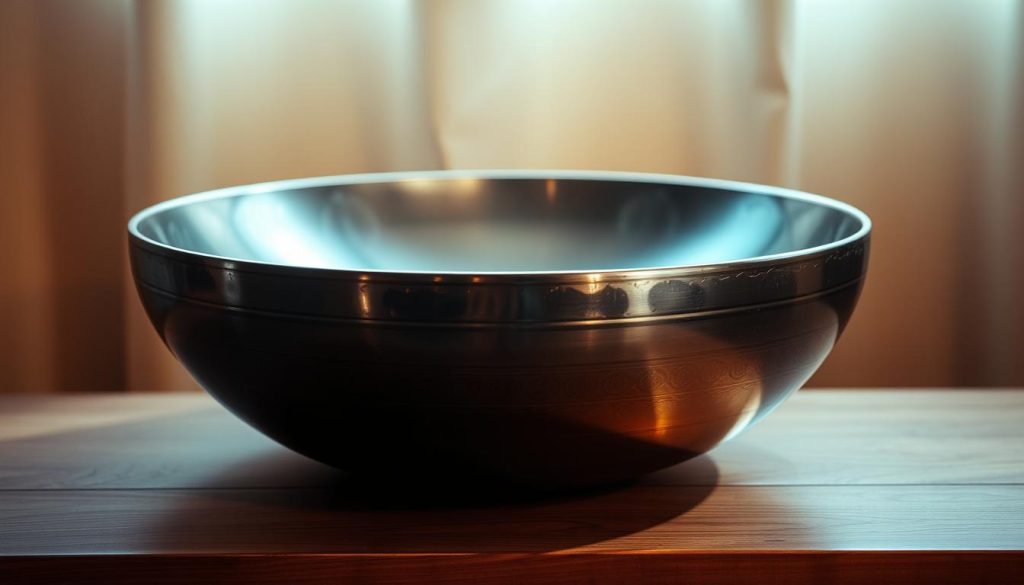
Discovering an instrument as unique as the handpan is a fascinating experience. Its enchanting sound and distinctive shape make it an ideal companion for musicians seeking harmony. But how should you go about making the right choice?
This guide helps you understand the technical specifications before you buy a handpan. Scales, tuning, sustain, and materials are key factors to examine. The number of notes also affects the instrument’s versatility.
Brands such as CosmoPan and PANArt offer quality models. The budget generally ranges from €1,000 to €3,500. Trying one in person, as recommended by Handpan France, remains the best way to experience every vibration fully.
The balance between sound quality and price is crucial. Take the time to explore the options and find the one that resonates with you.
What is a handpan?
Originating in Switzerland in 2001, the handpan is a melodic percussion instrument prized for its unique design and sound. Made from two steel shells, it produces crystal-clear notes through meticulous hand hammering.
Origins and characteristics of the instrument
Inspired by the Hang® created by PANArt, the handpan evolved into an instrument in its own right. Its structure includes:
- An upper shell (Ding) with a central note surrounded by secondary notes
- Dimples that optimize the quality of the sounds
- A lower shell (Gu) that amplifies resonance
Made from nitrided or stainless steel, it offers excellent durability. Its precise tuning enables rich harmonies that are ideal for contemplative or rhythmic music.
Why choose a handpan as your first instrument?
Several advantages make it a wise choice for beginners:
- Accessibility: no knowledge of music theory is required to create harmonious melodies
- Versatility: suitable for meditation as well as stage performances
- Tactile interaction: playing with your hands creates an immediate connection with the instrument
Many beginners report that it is easier to learn than other melodic percussion instruments. To explore more models, read our complete guide to handpans.
Whether you are seeking relaxation or artistic expression, the handpan offers endless possibilities. Its enchanting timbre captivates musicians and newcomers alike.
Understanding handpan scales
A well-chosen scale can turn your handpan practice into an emotional journey. It determines the mood of the notes and opens up unique creative possibilities.
Definition and importance of the scale
A scale is a sequence of harmoniously organized notes. On a handpan, it guides improvisation and influences the sound. The diatonic system (7 notes) is favored for its simplicity, unlike the more complex chromatic system (12 notes).
The different types of scales
Each scale creates a distinct atmosphere:
- Major (e.g., C major): joy and lightness, ideal for energetic melodies.
- Minor (e.g., D minor): profound melancholy, often used for meditation.
- Eastern: mystery and exoticism, perfect for ethnic compositions.
| Scale | Emotion | Typical use |
|---|---|---|
| Major | Optimism | Concerts, entertainment |
| Minor | Reflection | Yoga, relaxation |
| Eastern | Journey | World music |
Which scale should a beginner choose?
D minor is preferred by 60% of beginners because of its versatility. Its warm sound suits every style. Try several scales in a store to find the one that inspires you.
Avoid overly complex scales, such as the chromatic scale, if you are just starting. Favor clear notes and harmonic consistency.
Tuning: 432 Hz or 440 Hz?
432 Hz or 440 Hz? This question divides handpan enthusiasts. The tuning frequency shapes the character of the instrument, its emotional impact, and its compatibility with other music.
Characteristics of the 432 Hz frequency
432 Hz is often described as a “natural frequency.” Its advantages include:
- A soothing effect on the body, ideal for therapeutic music.
- Softer harmonics, close to the Earth’s vibrations.
- 70% of handpans sold in 2023 were models tuned to 432 Hz.
Advantages of 440 Hz
An international standard since 1953, 440 Hz offers:
- Perfect compatibility with traditional instruments (pianos, guitars).
- Brighter sounds, suited to group concerts.
- Shorter but precise resonance for complex rhythms.
How should you choose based on your needs?
Try both frequencies before buying. Here is a comparison guide:
| Criterion | 432 Hz | 440 Hz |
|---|---|---|
| Use | Meditation, well-being | Groups, stage |
| Resonance | Long and enveloping | Precise and dynamic |
| Market | 70% of sales | Orchestral standard |
Choose 432 Hz for relaxing solo practice. Choose 440 Hz if you play with other instruments. Sound quality should always take precedence over frequency.
Sustain: resonance duration and quality
The magic of a handpan lies in the persistence of its vibrations. Sustain, the ability to prolong notes, creates an enveloping bed of sound. It defines the instrument’s acoustic identity.
What is sustain?
Sustain measures how long a note resonates after it is struck. Good sustain (8 to 12 seconds) makes it possible to create fluid melodies. To test it, use a stopwatch and listen to the sound decay naturally.
“Balanced sustain is like breathing: neither too short nor too long, but just long enough to stir emotion.”
The ideal sustain for a beginner
Beginners should favor medium sustain (10 seconds). If it is too long, control can become difficult; if it is too short, expressiveness is limited. Here is a comparison by use:
| Style | Ideal duration | Example scale |
|---|---|---|
| Meditation | 10 to 12 sec. | D minor |
| Rhythmic | 8 to 10 sec. | C major |
Tips for preserving sustain:
- Avoid impacts to preserve the integrity of the steel.
- Clean the instrument regularly with a microfiber cloth.
- Store it in a temperature-controlled case (15 to 25°C).
Brands such as CosmoPan and Spacedrum excel in the quality of their instruments’ sustain. Their secret? Optimized steel thickness (1.2 mm) and precise hammering.
Evaluating sound quality
The listening experience of a well-tuned handpan instantly reveals its true value. Two technical criteria are essential when identifying an exceptional instrument: harmony between the notes and control of sonic interference.
Balance between notes
A good handpan offers excellent acoustic consistency. Here is how to check it:
- Alternating strikes: play each note in succession while listening for variations in volume.
- Spectral analysis: apps such as Spectroid detect imbalances between frequencies.
- Shell symmetry: asymmetrical construction alters the distribution of sounds.
“Perfection lies in what cannot be perceived: no note should dominate the others.”
Managing crosstalk
Crosstalk is interference between neighboring notes. An acceptable level remains below 15%. To measure it:
| Method | Ideal result |
|---|---|
| Isolation test | No audible unwanted vibration |
| In-store listening | Clarity maintained during rapid chords |
Tip: compare several models to explore handpan scales and their acoustic behavior. Reputable brands provide test reports confirming tonal stability.
Manufacturing materials
Two types of steel compete in the manufacture of modern handpans. Your choice affects durability, timbre, and even the ease of maintenance of your instrument.
Nitrided or stainless steel: the acoustic showdown
Nitrided steel offers short sustain but complex harmonics. Its surface coating requires diligent maintenance to combat oxidation.
Stainless steel stands out for:
- Natural corrosion resistance
- Warmer, more stable sounds
- Ideal suitability for humid areas
| Criterion | Nitrided | Stainless |
|---|---|---|
| Average weight | 4.2 kg | 3.9 kg |
| Service life | 8 to 10 years | 12 to 15 years |
| Average cost | +15% | Standard |
Guide for new players
Beginners should favor stainless steel because of:
- Its resilience against handling mistakes
- Its reduced maintenance requirements
- Its greater stability in variable climates
“Stainless steel provides a gentler learning curve without sacrificing sound quality.”
Brands such as Pantheon Steel excel in nitrided steel, while Aura Handpans has mastered stainless steel. Always request the maintenance kit suited to your type of steel.
Choosing the number of notes
The versatility of a handpan largely depends on its number of notes. This technical characteristic affects ergonomics, the complexity of playing, and creative possibilities.
Handpans with 9 notes or fewer
Standard models (Ding + 8 notes) are perfectly suited to beginners. Their simplified configuration offers several advantages:
- Faster learning: the ergonomic layout makes positions easier to memorize.
- Lower weight: approximately 3.5 kg, compared with 5 kg for complex models.
- Natural progression: lets you master basic techniques before moving forward.
Creative limitations exist, but they remain minimal for a first instrument. Most meditative melodies adapt perfectly to this configuration.
Instruments with 10 notes or more
These handpans require more advanced technique. Their main advantages include:
- A broader musical range for complex compositions
- The ability to play less common scales
- Richer resonances through interactions between the notes
Playing them requires advanced coordination. Here is a technical comparison:
| Model | Notes | Weight | Diameter |
|---|---|---|---|
| Beginner | 9 | 3.5 kg | 50 cm |
| Advanced | 12 | 5.2 kg | 55 cm |
“Start simply: a good musician creates emotion with few notes, not soulless complexity.”
For a first purchase, prioritize sound quality over the number of notes. Brands such as Pantheon Steel offer excellent 9-note models.
Is price an indicator of quality?
The handpan market has significant price differences based on origin and manufacturing. A basic model costs around €900, while pieces from renowned makers exceed €2,000. This difference is explained by the working time and acoustic expertise involved.
Reasonable price ranges
Here is what you get at each level:
- €900 to €1,500: a good entry-level instrument with decent sound, ideal for beginners
- €1,500 to €2,000: a professional finish and optimized sustain
- More than €2,000: unique pieces with custom tuning
“A handpan costing less than €800 may disappoint in terms of tonal stability. European craftsmanship is worth the price.”
Avoiding the pitfalls of very low prices
Tempting offers often conceal:
- Untreated steel that oxidizes quickly
- Notes that go out of tune after a few months
- No manufacturer’s warranty
| Criterion | Budget model | High-end craftsmanship |
|---|---|---|
| Service life | 2 to 3 years | More than 10 years |
| Production time | 1 month | 6 to 18 months |
To buy a handpan wisely, favor rent-to-own programs. They allow you to test the instrument before making the final purchase. The five-year return on investment is excellent for high-end models.
Aesthetics and design
A handpan’s appearance reflects its personality as much as its sound does. Finishes and colors influence its visual appeal while also affecting its acoustic performance.
Color palette and surface techniques
Makers now offer a variety of options:
- Matte finish: absorbs light for an understated appearance, ideal in the studio.
- Gloss finish: reflects spotlights, perfect for performances.
- Laser engraving: makes it possible to create custom patterns without altering the material.
Modern metallic pigments preserve resonance. Trends in 2024 favored blue-green gradients and sandblasted finishes.
Durability and special care
Your choice of finish determines the required maintenance:
| Type | Cleaning | Frequency |
|---|---|---|
| Matte | Dry cloth | Weekly |
| Gloss | Anti-smudge product | Monthly |
“UV protection is essential for preserving the vivid colors of contemporary models.”
Some brands offer 3D simulators for visualizing your future handpan. This innovation makes the choice easier before purchase.
Always favor compatibility with future touch-ups. Proper maintenance preserves the instrument’s beauty for decades.
Where should you buy your first handpan?
Finding the right place to buy a handpan is crucial to ensuring its quality and your enjoyment of playing. The available purchasing channels vary, and each has specific advantages.
Specialist stores: the assurance of professional service
The Handpan France network has 12 physical showrooms. These spaces offer:
- Expert advice to help you buy a handpan wisely
- The opportunity to try several models
- Full traceability of the manufacturer
Certified platforms such as Handpan Masters offer:
| Advantage | Store | Private seller |
|---|---|---|
| Warranty | At least 2 years | None |
| Trial | Yes | Rarely |
Private sellers: caution required
Private listings can conceal pitfalls. Here is a checklist:
- Check its usage history
- Require proof of purchase from the manufacturer
- Test every note before the transaction
“A used handpan should have fewer than 500 hours of playing time to retain its original tuning.”
The advantage of in-store trials
Nothing replaces direct contact with the instrument. Stores now use:
- A COVID health protocol for trials
- Demonstrations guided by professionals
- An acoustic comparison between models
For professionals, buying in a store offers tax advantages (recoverable VAT). View our interactive map of authorized dealers.
Try before you buy: practical advice
Before purchasing, it is essential to test your future handpan in person. This step reveals aspects that are invisible on paper. A good trial combines technical evaluation with an emotional response.
Key parameters to check
During a trial, focus on 5 factors:
- The balance between notes (consistent volume)
- Responsiveness to a light touch
- The absence of unwanted vibrations
- Tuning stability
- Ergonomic comfort
Use this 7-step method:
- Play each note separately
- Try rapid sequences
- Listen to the resonance with your eyes closed
- Check the response to variations in striking force
- Compare several scales
- Analyze the quality of the harmonics
- Write down your overall impression
“You choose a handpan with your ears and heart, not just your wallet.”
Evaluating digital demonstrations
When an in-person trial is impossible, critical listening becomes crucial. Favor professional recordings such as those in this demonstration library.
Free analysis tools:
- Audacity for visualizing frequencies
- Tuning apps for checking the tuning
- Sustain comparison tools (Waveform)
When listening, pay attention to artifacts:
| Problem | Detection |
|---|---|
| Excessive compression | Lack of natural high frequencies |
| Artificial reverberation | Disproportionate echo |
Create a comparison sheet for each model. Note the clarity of the notes and the depth of the bass. These factors will guide your final choice.
Essential accessories
Protecting your musical investment begins with choosing the right accessories. A handpan requires specific protection and diligent maintenance to preserve its acoustic qualities.
Cases and protection
A temperature-controlled case (€150 for a mid-range model) is vital for:
- Preventing impacts during transport
- Maintaining stable humidity
- Protecting the instrument from temperature fluctuations
Comparison of protection systems:
| Type | Advantage | Average price |
|---|---|---|
| Hard | Maximum protection | €200 |
| Soft | Lightweight | €90 |
“A custom case preserves tuning better than a standard model.”
Maintenance products
Special organic oil (€25 for 50 ml) conditions the steel without leaving residue. Apply it:
- After every playing session
- Before prolonged storage
- In an ultrathin layer
Homemade wax recipe:
- Organic beeswax: 30 g
- Coconut oil: 10 ml
- Lemon essence: 2 drops
Seasonal maintenance schedule:
| Season | Action |
|---|---|
| Spring | Deep cleaning |
| Summer | UV protection |
Consider insuring your instrument. This insurance covers:
- Accidental damage
- Theft with proof of purchase
- Repairs by the maker
Environmentally responsible brands such as EcoPan offer complete kits. Take the time to compare the options for your handpan.
Conclusion
The emotion created by a well-chosen handpan is unforgettable. Remember these essential criteria: tuning, sustain, materials, and number of notes. Always prioritize the sensory experience during your selection.
Handpan France offers introductory sessions to refine your choice. The market is moving toward more affordable models without sacrificing sound quality.
Your instrument deserves special attention. Try several scales in a store to find the one that resonates with you. The magic happens when sound meets emotion.