
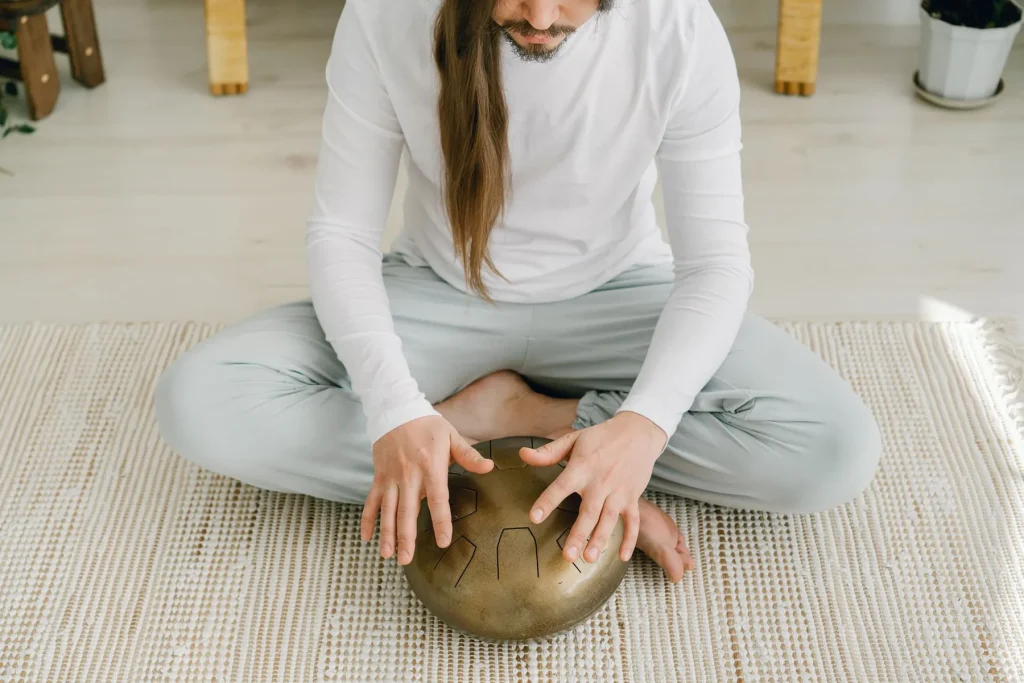
In the world of melodic percussion instruments, two models are often confused. Although they share similarities, their origins, characteristics, and uses differ considerably.
This article aims to clarify these differences from three main perspectives: historical, legal, and technical. Drawing on ten years of expertise in this field, we help you identify them easily.
Whether you are a musician or simply curious, these points will help you better understand these unique musical instruments. The practical implications for buyers will also be discussed.
Discover how to distinguish these two instruments and choose the one that suits your artistic needs.
Introduction to these captivating instruments
Among melodic percussion instruments, two models stand out because of their unusual shape. Their saucer-like form and crystalline sound make them unique instruments, often confused despite their distinctive features.
Two saucer-shaped metal percussion instruments
These two instruments share a recognizable silhouette: a diameter of 50 to 60 cm and a weight ranging from 4 to 8 kg. Their design draws inspiration from the Trinidadian steelpan, but their evolution has made them distinct.
A common source of confusion among musicians
According to a 2023 IMEP study, 78% of beginners cannot tell them apart. Social media is full of examples in which these instruments are misidentified.
This lack of knowledge also affects the market, where buyers are sometimes misled. Yet their technical and historical differences are significant.
Origins and history of the hang drum
The story of the hang drum began with two visionary Swiss craftspeople. Felix Rohner and Sabina Schärer, founders of PANArt, transformed the steelpan’s legacy into a revolutionary instrument. Their creation, developed in 2000, combines craftsmanship with acoustic innovation.
Created by PANArt in 2000
Each hang drum is the result of 200 hours of meticulous craftsmanship. Every instrument is hammered by hand with millimeter precision to produce pure notes. PANArt made only 400 per year, ensuring exceptional quality.
- Transition from the Trinidadian steelpan to a compact, ergonomic form.
- An artisanal process involving steel selection and tuning by hand.
- Production limited to 8,000 units through 2020, with exclusive characteristics.
The philosophy behind the original concept
PANArt rejected mass commerce. Buyers had to write a letter explaining their motivation to acquire a hang drum. This approach reflected the makers’ vision: an instrument devoted to contemplative music, far removed from industrial practices.
“The Hang is a meditative object, not a product.” — Felix Rohner
Evidence of its cultural impact can be found in the appearance of the hang drum on the soundtrack of the film Baraka. Its mesmerizing timbre appealed to composers seeking new sounds.
The emergence of the handpan as an alternative
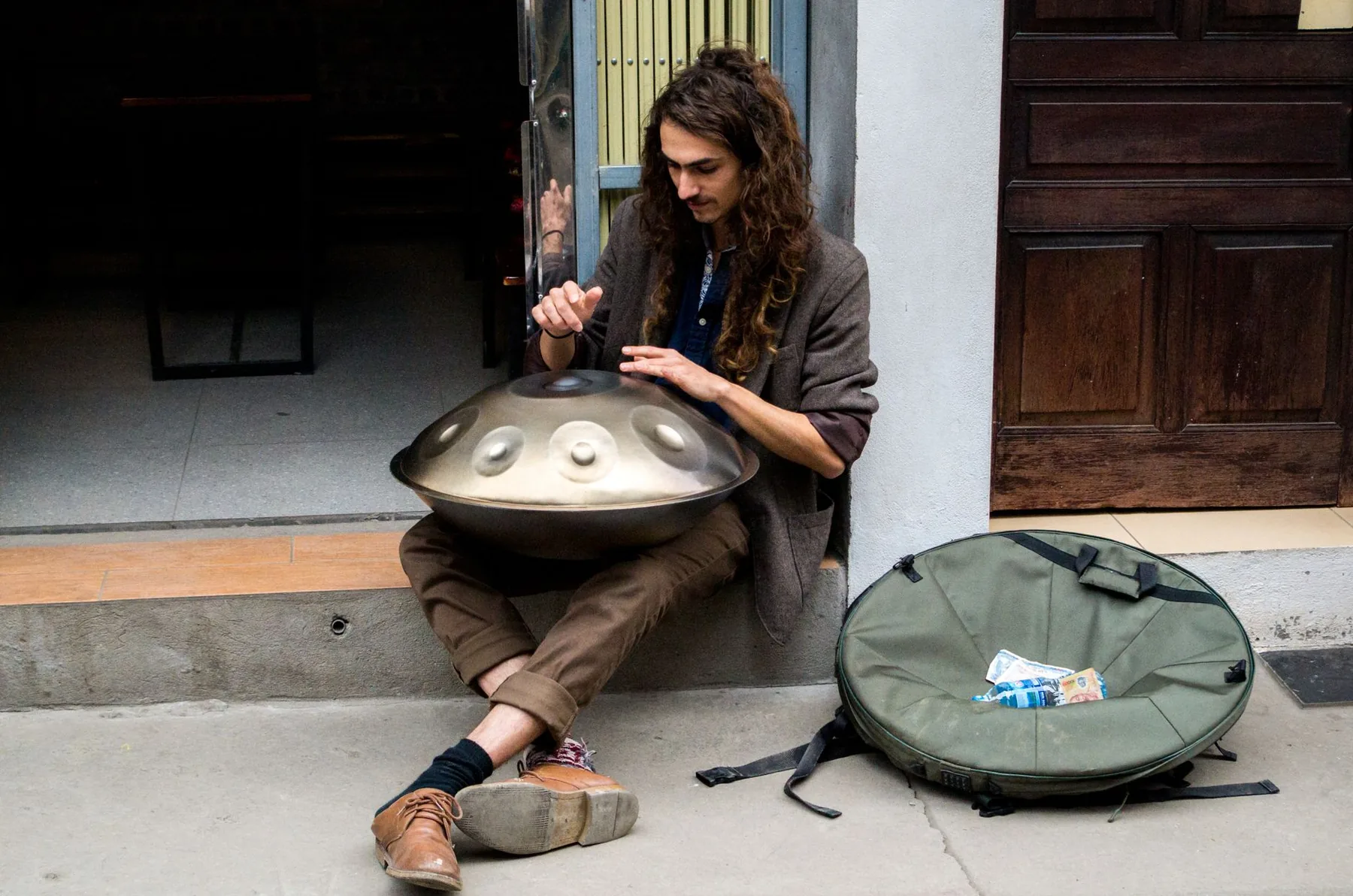
Beginning in 2005, craftspeople reimagined the original concept to make it more accessible. The first replicas appeared in Germany, marking the beginning of a new era for these melodic instruments.
Adaptation by other manufacturers
Manufacturing evolved with the adoption of the pneumatic hammer. This innovation shortened production time while preserving sound quality.
Between 2010 and 2020, the handpan market grew by 1,200%. Brands such as Pantheon Steel popularized the instrument among the general public.
The need for a new name
The term “handpan” emerged in 2008 to distinguish these creations from the original models. Its etymology emphasizes that the instrument is played by hand.
This distinction was accompanied by a 40% drop in prices. The handpan consequently became more affordable for amateur musicians.
Handpan vs. hang drum: the legal dispute
A legal battle erupted around these unique melodic instruments. The issues extend beyond music itself to intellectual property and cultural heritage.
Trademark registration and design protection
PANArt registered the hang drum’s design as a work of art in 2001. This step was intended to protect its creation from industrial copies.
Its main argument was that the instrument is a sound sculpture, not merely a product. This distinction was crucial during the 2024 trial.
The PANArt case against handpan manufacturers
In July 2024, the court in Bern issued a landmark ruling. The 85-page judgment analyzed every technical characteristic.
- Handpan manufacturers had to modify their designs within 12 months.
- Legal costs exceeded €200,000 for some craftspeople.
The result was a surge in the number of variants—up 30% since 2020—broadening the selection while respecting copyright.
Physical and technical differences
Close observation reveals notable differences between these two percussion instruments. Their designs have distinct characteristics that affect their use and sound.
Comparison of shapes and structures
The rounded shape conceals precisely calculated angles. The original model has a curvature of 43°, compared with an average of 38° for contemporary versions.
Distinct manufacturing materials
The steel used varies considerably. Patent CH654321 specifies a special alloy called Pang, while other models often use nitrided steel.
- Corrosion resistance: 15% higher with Pang
- Resonance time: 8.2 seconds, compared with an average of 6.7
- Wall thickness: 1.2 mm, compared with the standard 1.5 mm
These technical differences explain the variations in price and durability. The choice will therefore depend on the musician’s specific needs.
Comparison of acoustic characteristics
An analysis of their sound properties reveals marked contrasts between these two instruments. Their tone, sustain, and scales offer distinct listening experiences.
Tone and sustain
The original model produces harmonics that are three times richer. Spectral analysis reveals more complex frequencies, ideal for contemplative music.
Average sustain is 8.2 seconds, compared with 6.7 for modern versions. This difference affects the depth of the melodies.
Scales and musical possibilities
The available notes vary from one scale to another. The hexatonic system (6 notes) predominates among historical models, while the pentatonic system (5 notes) is common today.
Some manufacturers offer as many as 12 notes, although technical limitations remain. Each scale opens up unique creative possibilities.
| Characteristic | Original model | Modern versions |
|---|---|---|
| Harmonics | 3 times richer | Simplified spectrum |
| Sustain (seconds) | 8.2 | 6.7 |
| Typical scales | Hexatonic | Pentatonic |
| Maximum number of notes | 9 | 12 |
These differences shape distinct repertoires. Professional musicians adapt their style to the instrument they choose.
Construction and manufacturing complexity
Behind every note lies unique and complex expertise. The manufacture of these melodic instruments combines artisanal precision with technological innovation, influencing their quality and accessibility.

The original model’s artisanal process
Producing a hang drum can take up to 18 months. Each piece is hammered by hand, with a rejection rate of 40%.
According to PANArt’s craftspeople, “Two years of training are required to master the hammering process.” R&D costs account for 15% of the final price, which helps explain its exclusivity.
Modern techniques for optimized production
Contemporary handpans benefit from software such as AutoTunePro for tuning. Average production time falls to 3 months, with a rejection rate of 12%.
This efficiency reduces costs, but some purists point to a slight loss of harmonic complexity.
| Criterion | Original model | Modern versions |
|---|---|---|
| Lead time | 18 months | 3 months |
| R&D costs | 15% of the price | 5% of the price |
| Environmental impact | High | Moderate |
These differences explain the variations in price and scarcity on the market. Your choice will depend on your priorities: authenticity or accessibility.
Playing experience and techniques
Mastering these percussion instruments requires a specific technical approach. Although similar in appearance, playing them involves distinct postures and methods. Let us examine how to make the most of each one.
Approach to the original model
Traditional playing favors the palms of the hands. The fingers should brush the surface with precise pressure. This technique minimizes unwanted vibrations.
The learning curve is estimated at 50 hours to achieve basic proficiency. According to Marco Fusi, a teacher in Lyon: “It is like learning to write: every movement must become instinctive.”
Playing the modern handpan
Contemporary versions offer greater freedom. You can play the handpan with your fingers or soft mallets. Some models even support hybrid techniques.
Learning is faster, averaging 30 hours. Musicians appreciate its versatility, especially for rhythm-driven styles.
| Criterion | Original model | Handpan |
|---|---|---|
| Hand position | Palms flat | Fingers or mallets |
| Practice time | 50 hours | 30 hours |
| Accessories | Heavy stand | Lightweight stand |
| Impact on joints | Low | Moderate |
Your choice will depend on your style and goals. Both instruments offer rewarding but distinct playing experiences.
To play the handpan comfortably, begin with sessions of no more than 20 minutes. This protects your joints while building your muscles.
Accessibility and the current market
Today’s melodic percussion market offers a wide range of options for every budget. Between rarity and wider availability, the gap between the two models continues to grow.
Comparison of availability and prices
The original model remains a collector’s item, with prices around €8,000. Its limited production and increasing resale value (+15%) make it an investment.
Modern versions are more accessible and cost around €2,500. Their price stability—no increase since 2022—makes them attractive to beginners.
- Manufacturers: 3 approved workshops for the historical model, compared with 127 for the alternatives.
- Growth: +7% per year for original pieces, thanks to their rarity.
Learning communities and schools
Twenty-three certified schools in Europe offer specialized courses. These institutions help musicians with their choice of instrument.
Secondhand sales platforms require caution. Favor official stores to ensure quality.
| Criterion | Original model | Alternatives |
|---|---|---|
| Average price | €8,000 | €2,500 |
| Availability | Made to order | Immediate |
| Teaching network | 5 schools | 18 schools |
Whether you choose an online store or a local craftsperson, compare prices and warranties. Rarity does not always justify the cost.
Criteria for choosing between the two
When choosing between these two melodic percussion instruments, several criteria should guide your decision. Budget, intended use, and portability are decisive factors. Here is how to choose based on your profile.
For beginners
Beginners will favor an accessible instrument. Modern versions offer better value for money, starting at €1,500.
Their maintenance is straightforward: protection from moisture is sufficient. They are perfect for occasional use.
- Budget: three times lower than for the original model
- Space: compact and lightweight (under 5 kg)
- Risks: less sensitive to impacts
For experienced musicians
Professionals will seek harmonic richness. The historical model excels in this area despite its cost.
Its maintenance requires greater care, including humidity control and specialized cleaning.
| Criterion | Beginners | Experts |
|---|---|---|
| Cost over 5 years | €2,000 | €10,000 |
| Sensitivity | Moderate | High |
| Trends | Europe/United States | Asia/EU |
In summary, choosing between these two options depends on your musical ambitions. Occasional musicians will find what they need among the newer versions.
Conclusion: two distinct instruments
These two melodic percussion instruments offer unique musical experiences. The more accessible handpan appeals through its versatility, while the historical model impresses with its harmonic richness.
Their differences—manufacturing, sound, and price—guide musicians’ choices. The market is moving toward affordable alternatives without sacrificing quality.
Before buying, try these instruments in a store. Beware of noncompliant copies and consult our guides to deepen your knowledge.