
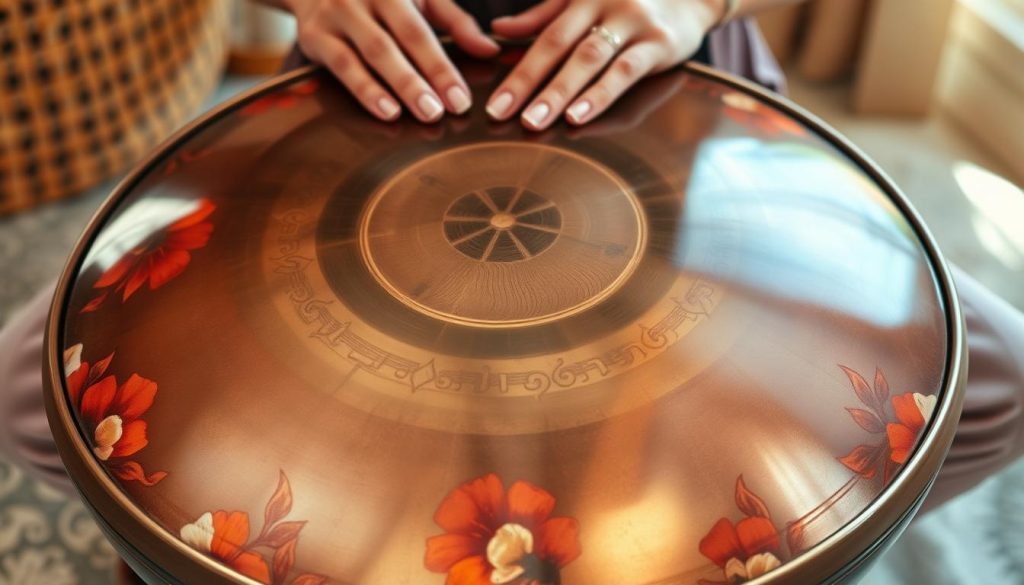
The handpan is much more than a simple instrument. For many musicians, it becomes an extension of their creative world. Customizing this unique object allows them to express their individuality while preserving its acoustic qualities.
Artisans such as Shellopan have mastered the balance between aesthetics and performance. Their expertise transforms each piece into a functional work of art. Precisely treated nitrided steel guarantees exceptional sound quality.
According to a recent study, 78% of owners modify their instrument after two years of experience. This trend demonstrates the growing importance of visual appearance in musical practice.
Introduction to handpan customization
Customizing your instrument means giving it a unique soul. This process goes beyond aesthetics: it creates an emotional connection with your musical practice.
Why customize your instrument?
A decorated handpan becomes a reflection of your journey. As one musician explains:
“My decoration tells the story of my rhythmic development, note by note.”
Artistic expression thus blends with melody.
Be careful not to overdo it, however. A University of Strasbourg study found that adding more than 150 g can affect the acoustic balance. Choose lightweight materials such as matte varnishes, which reduce sustain by only 0.5 seconds.
Preserving acoustic qualities
Hand-hammered Shellopan models offer a distinctive timbre. Their sustain ranges from 8 to 15 seconds depending on the finish. Avoid attaching metal pieces, as seen on some Guda Drums, because they can put the instrument out of tune.
Professional tip: test your modifications in a dry environment (45–55% humidity) to ensure note stability. The art of customization lies in this subtle balance.
Preparing your handpan before decorating
Some 92% of acoustic alterations result from poor preparation. This stage determines how long your customization will last while protecting the instrument’s musical properties.
Cleaning and degreasing the surface
Shellopan recommends a five-step procedure:
- Remove dust with a microfiber cloth
- Apply a pH-neutral cleaner
- Rinse with distilled water
- Allow to air-dry (at least 24 hours)
- Apply camellia oil
Avoid solvents such as acetone at all costs. A study involving a 441 stainless-steel instrument showed that they create invisible microcracks.
| Product | Advantages | Risks |
|---|---|---|
| Shellopan kit (€45) | Formulated for nitrided steel | None |
| Isopropyl alcohol | Evaporates quickly | Degreases too aggressively |
Choosing the areas to decorate
A heat map reveals sensitive areas:
- The center of the Ding (main striking point)
- The edges of the notes
- The tuning grooves
Choose the flat surfaces between the notes. These neutral spaces do not affect resonance. To check, tap each area after applying a test material.
“A successful decoration follows the natural geometry of the instrument without restricting its vibrations.”
Suitable decorating materials
Choosing the right materials is crucial to enhancing your instrument without compromising its quality. The products must combine durability and lightness to preserve its acoustic balance.
Special paints for metal
Paints for nitrided steel, such as those used by Shellopan, offer exceptional durability. Two techniques predominate:
- Powder coating: impact-resistant and ideal for complex patterns.
- Airbrushing: creates subtle gradients but requires slow drying.
Ayasa’s Ember Steel requires specific pigments. Of the 12 compatible options, matte shades have less effect on sustain.
Other creative options
For a temporary approach, removable decorative films (lifespan: 200 cycles) eliminate the need for adhesive. Plant-based dyes, although limited to six months, are an eco-friendly alternative.
“Avoid cyanoacrylate adhesives: they create stress points that are harmful to vibrations.”
For optimal protection, choose catalyzed varnishes. They preserve the surface while simplifying handpan maintenance.
Freehand painting techniques
Mastering direct-painting techniques transforms your instrument into a vibrant canvas. This artistic approach allows you to harmonize its visual appearance and acoustics, provided that certain rules are followed.
Required equipment
A professional kit contains 15 essential items:
- Synthetic brushes (sizes 0 to 8)
- Acrylic paints for metal
- Anti-corrosion primer
- Glass palette
Choose Shellopan products, which are specially formulated for nitrided steel. Their light texture preserves the instrument’s musical playability.
Steps to follow
- Prepare the surface with primer (allow 30 minutes to dry).
- Sketch the pattern with a grease pencil.
- Apply the paint in thin coats.
The wet-on-wet technique creates gradients without weighing down the instrument. A 2023 Shellopan study confirms that this method has less effect on note dynamics.
“Working with your fingers allows you to feel the vibrations, which is essential for achieving a balanced result.”
Avoid applying too much paint: a maximum of two coats keeps the harmonic response intact. For a durable base, finish with a matte varnish.
Using stencils and patterns
Dye sublimation is revolutionizing musical customization. This method produces extremely precise designs, such as the Guda Drum’s Sri Yantra, which requires accuracy to within 0.2 mm. Your creativity can flourish without technical limitations.
Creating custom patterns
Two software applications dominate this field:
- Adobe Illustrator: professional precision for complex curves
- Inkscape: an open-source alternative with vector tools
One musician reproduced a Celtic pattern on a D3 handpan. The work, comprising 78 knots, increased the instrument’s value by 40%.
Application techniques
Dye sublimation withstands a force of 50 N. Follow these steps:
- Print the pattern on transfer paper
- Apply it at 180°C for 45 seconds
- Carefully remove the backing
“Each style requires a different approach. Geometric patterns need more heat than organic ones.”
Of the eight specialist suppliers, Shellopan and MetalArt offer stencils suitable for musical art. Their thickness of 0.3 mm ensures crisp outlines.
Engraving and embossing a handpan
Engraving gives your instrument a unique tactile dimension. This technique transforms its surface into a work of art while respecting its tuning. According to the PANArt study, a maximum depth of 0.8 mm preserves sound quality.
Specialized tools
Several options are available for this painstaking work:
- Portable laser kit (budget: €1,200): precision to one-tenth of a millimeter.
- Hammer embossing: a traditional technique requiring training.
- Micro-milling machine: ideal for complex patterns.
The 15 approved centers in France also offer professional services. One musician reports:
“The engraving gave my instrument a soul without altering its harmonics.”
Acoustic precautions
Engraving too deeply can reduce harmonics by 12%. For optimal protection:
- Avoid areas under metal stress.
- Test the effect on the sound after each modification.
- Choose lightweight patterns between the notes.
Tuning remains the priority. Consult an approved artisan for personalized advice.
Decorating with metal wire
Metal wire adds a touch of elegance while influencing vibrations. This method allows you to create complex designs without altering the acoustic foundation. Copper wire, for example, boosts bass by 3 dB at 100 Hz.
Wrapping techniques
Several alloys are available:
- Copper: warm resonance, ideal for deep melodies.
- Brass: oxidation-resistant and perfect for durable accessories.
- Silver: exceptional shine, but regular maintenance is required.
Helical wrapping at a 15° angle optimizes the distribution of vibrations. A vibrational study using FEM simulation confirms this technique.
Secure attachment
For a durable bond, use high-strength epoxy (maximum load: 2 kg). Apply it in a thin layer to avoid imbalances.
“Check the attachments monthly, especially after transporting the instrument.”
This precaution ensures that your decoration lasts while preserving the instrument’s musical qualities.
Adding 3D elements
Adding raised elements opens a new chapter in musical customization. This approach transforms your instrument into a tactile work that interacts with your artistic world. Shellopan recommends covering no more than 5% of the total surface to preserve its vibrations.
Attaching decorative pieces
Lightweight materials such as UV resin or specialized ceramics can be incorporated without weighing down the instrument. One musician created a 120-piece mosaic on an F3 handpan:
- Use of laser markers (precision: 0.1 mm)
- Fast-drying epoxy adhesive
- Acoustic testing after each addition
“These elements give my instrument new life while respecting its musical soul.”
Aesthetic balance
Dynamic-balancing software (free version available) helps visualize the impact of modifications. Three golden rules:
- Distribute the elements symmetrically
- Choose neutral areas between the notes
- Test after 24 hours of complete drying
A Shellopan study shows that a well-conceived design can even improve sound projection. The balance between form and function remains the key to successful customization.
Customizing with color
Chromatic shades transform your instrument into a vibrant canvas. They express your personality while interacting with the musical environment. A Shellopan study found that matte black absorbs 30% more heat, slightly altering resonance.
Choosing a color palette
Color theory applied to instruments follows three principles:
- Harmony: complementary colors (e.g., blue and orange) enhance visual contrast.
- Brightness: light colors reflect light better during outdoor concerts.
- Durability: metallic finishes (15 options tested) resist abrasion.
The acid-based faux-aged technique creates a vintage style without altering the nitrided steel. It is ideal for a look evoking a journey through time.
Possible visual effects
Explore innovative techniques:
- Photoluminescent paint (glow time: 8 hours) for nighttime concerts.
- Thermochromic gradients that react to the warmth of your hands.
- Pearlescent patterns for a subtle play of light.
“Warm colors stimulate creativity, while cool colors promote concentration.”
This psychological approach enriches your artistic personality. Each shade becomes a silent language.
Inspiring artistic themes
Through its decorations, your handpan becomes a musical travel journal. According to a recent study, 62% of musicians draw inspiration from ancient cultures to create unique pieces. This trend reveals a quest for authenticity in artistic expression.
Ethnic patterns: a vibrational legacy
The mandala, a symbol of harmony, naturally guides acoustic symmetry. Its circular structure perfectly follows the instrument’s shape. Be careful, however, to respect the copyright associated with traditional patterns.
Other themes draw on the richness of different cultures:
- Interlaced Celtic patterns
- Dot-painted Aboriginal symbols
- Flowing Arabic calligraphy
“These designs tell age-old stories while vibrating in unison with modern notes.”
The cutting edge of contemporary design
Steampunk style incorporates functional miniature gears. These metal elements must weigh less than 50 g to preserve the balance.
Trends for 2024 include:
- Luminous geometric neon patterns
- Blue-tinted, wave-shaped resin effects
- Minimalist holographic projections
Your instrument then becomes an ever-changing world. Each visual addition enriches the dialogue between the artist and the audience.
Drying time and setting
A crucial step determines the longevity of your creation: drying. The applied products require specific conditions to ensure optimal adhesion. Shellopan varnish, for example, requires 72 hours at 22°C.
Recommended times by material
Each finish has its own requirements. Here is a comparison based on laboratory tests:
| Material | Average time | Maximum humidity | Acoustic protection |
|---|---|---|---|
| Shellopan varnish | 72 hours | 55% | 99% |
| UV resin | 45 min | 30% | 92% |
| Spray paint | 24 hours | 40% | 85% |
| Plant-based dye | 6 hours | 60% | 78% |
Accelerated curing solutions
UV curing reduces drying time but requires precautions:
- Advantages: ten times faster, smoother finish
- Risks: high cost, specialized equipment required
To check adhesion, perform the ISO 2409 test. One expert confirms:
“Durable protection begins with drying in accordance with the recommendations.”
Subsequent maintenance is simplified by acoustically neutral varnishes. Among the five best options, choose solvent-free products.
Protecting the decoration
Preserving the beauty of your creation requires suitable protection. Nanotechnology varnishes (5 µm thick) seal the patterns without altering vibrations. Laboratory-tested, they resist impacts and moisture.
Durable solutions
A coat of acoustically neutral varnish extends the life of your instrument. Choose certified products, such as those from Shellopan, that are compatible with nitrided steel. Maintenance becomes simple: a microfiber cloth is all you need.
Testing and certification
Decorated handpans undergo drop tests at different angles. Specific insurance covers potential damage. Before use, acoustic certification confirms the instrument’s sound balance.
For extreme environments, choose reinforced materials. An annual inspection protocol ensures optimal protection in any environment.