
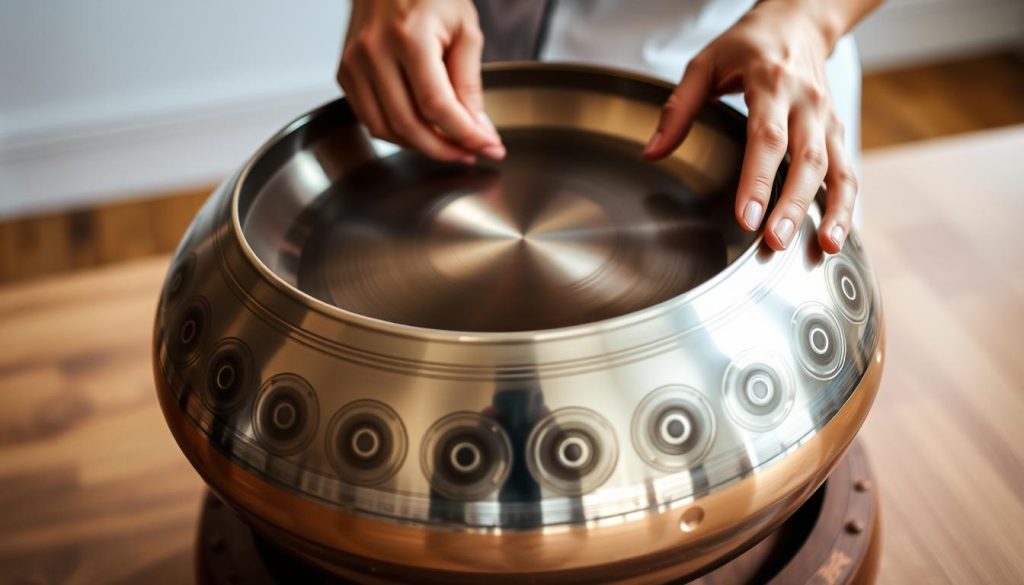
An instrument like the handpan requires regular maintenance to preserve its sound quality. Tuning is essential for maintaining its pure, harmonious notes.
Drawing on 10 years of experience, I share in this article the keys to understanding the importance of precise adjustment. A professional is often needed to carefully adjust each note.
A well-tuned handpan reveals its full musical richness. This fosters creativity and provides a unique sound experience. Find out how to care for your instrument so you can enjoy it to the fullest.
Why does a handpan go out of tune?
A handpan gradually loses its tuning due to various factors. Although durable, its steel undergoes invisible changes over time.
Natural wear caused by playing
Each strike slightly alters the structure of the metal. After thousands of impacts, the notes change in frequency. Intensive techniques such as ding bending accelerate this process.
Impacts and temperature fluctuations
An impact or fall can deform the steel. Thermal expansion caused by sunlight or a radiator can also throw the instrument out of balance. Avoid sudden exposure.
The impact of steel quality
Nitrided metal is more resistant than stainless steel. Thickness (1 to 1.2 mm) also affects longevity. On average, a handpan goes out of tune after 2 to 5 years.
How can you tell whether your handpan is out of tune?
A melodic instrument like this requires regular checks. Several methods can detect an imbalance in its frequencies. Here is how to do so effectively.
Checking by ear: limitations and tips
The human ear can perceive dissonance, but it has its limits. A slightly out-of-tune played note may go unnoticed. Train your ear by comparing it with reference recordings.
For a reliable test, isolate each note. A metallic sound or lack of sustain often indicates a problem. Nevertheless, this method remains subjective.
Using an electronic tuner or an app
Digital tools provide the necessary accuracy. Apps such as Spectroid analyze the sound spectrum in real time. Set the tuner to 440 Hz (or 432 Hz, depending on your preference).
Place your smartphone near the instrument. Strike each area and observe the results. A good tuner will display the exact frequency and the deviation in cents.
Interpreting the results (tolerance in hertz or cents)
The ISO 16:1975 standard allows a margin of 10 cents. Within this range, the instrument is still considered in tune. For a D Kurd handpan, these are the target values:
- Central Ding: 294 Hz (D4)
- Surrounding notes: 330 to 587 Hz
A deviation greater than ± 0.5 Hz requires adjustment. Consult this comprehensive guide to learn the specific thresholds.
Beware of low-quality microphones, which distort measurements. Choose a quiet environment to obtain reliable results. A single discordant played note can reveal that the instrument is generally out of tune.
Preparing to tune your handpan
Before adjusting your instrument, several steps are crucial to ensure the best possible result. Poor preparation can permanently alter the sound quality or damage the structure.
Essential tools
A rubber mallet is ideal for delicate adjustments. Unlike nylon, it reduces the risk of marking the steel. A Korg tuner provides greater accuracy when detecting minute tuning deviations.
A luthier’s vise and an anti-vibration support stabilize the instrument during the work. Hearing protection is recommended for extended sessions.
Protecting the instrument during the work
Place the handpan on a stable, padded surface. Avoid any contact with metal objects that could scratch its original shape.
Temporary storage in a temperature-controlled environment (20 to 22°C) preserves its thermal balance. Excessive humidity must be avoided to prevent rust.
When to avoid attempting to tune it yourself
If the instrument has suffered a severe impact or its shells have separated, entrust the instrument to a professional. Active rust or major deformation also requires expert attention.
“90% of damaged handpans are damaged as a result of poorly executed self-tuning attempts,” explains a repair specialist at Riviera Steel Tuning.
For complex cases, this brand offers customized solutions with a warranty.
How to have your handpan tuned: methods
Mastering a handpan’s harmony requires a methodical approach. Depending on the condition of the instrument, different techniques are available. Here is how to work precisely while preserving its tonal balance.
Striking techniques and fine DIY adjustment
Micro-strikes, such as those used by Josh Rivera, adjust the tension of the notes. Use a rubber mallet to produce gentle impacts. Striking 2 cm from the edge alters the structure without risking a crack.
An electronic tuner guides the adjustments. Aim for a tolerance of ± 5 cents per note. This method requires patience and a trained ear.
The benefits of using a professional
An expert ensures lasting results. Their experience helps prevent costly mistakes. They use specialized tools, such as ball-peen hammers.
The process includes:
- A complete diagnosis of the notes
- Correction of disrupted harmonics
- A stability test after adjustment
Dealing with serious damage
Shell separation after an impact requires a specific bonding process. The work often takes 3 weeks. For older handpans, avoid direct hammering.
“Retuning after a fall may require partial replacement of the steel,” notes a specialist luthier.
Always choose a workshop that provides a written warranty. The art of tuning lies in this expertise.
How much does professional tuning cost, and how should you choose a tuner?
Investing in a good tuning service can save your instrument from becoming irreversibly out of tune. Here is what you need to know to set your budget and select an expert.
Average price in France (€100 to €300)
The price depends on the extent of the adjustments. Tuning a single note costs around €50 to €100. For a completely out-of-tune instrument, expect to pay €200 to €300.
Some makers, such as Handpan.World, offer €150 packages with a warranty. Urgent work may increase the bill by 20%.
Criteria for selecting an experienced tuner
Choose a professional who has the following:
- An audio and video portfolio of their work
- Recognized certifications in the percussion world
- Verified customer reviews (Google My Business, specialist forums)
Ask for a preliminary diagnostic video. A good service always includes this step.
Warranties and turnaround times to require
Require a written 3- to 6-month warranty covering note stability. The usual turnaround time is 2 weeks, although it varies by workshop.
“Tuning without a warranty is an unnecessary risk. Always check the stability clauses.”
Tip: negotiate annual maintenance to reduce long-term costs.
Conclusion
Taking care of your instrument ensures years of captivating melodies. Causes of detuning, such as impacts or wear, require precise work. Always entrust handpan tuning to a professional to avoid irreversible damage.
Explore the history of this fascinating instrument through specialist resources such as those from Instruments du Monde. Proper storage and twice-yearly checks extend its lifespan.
By investing in quality, you will reduce the frequency of adjustments. The magic of the handpan deserves this care.