
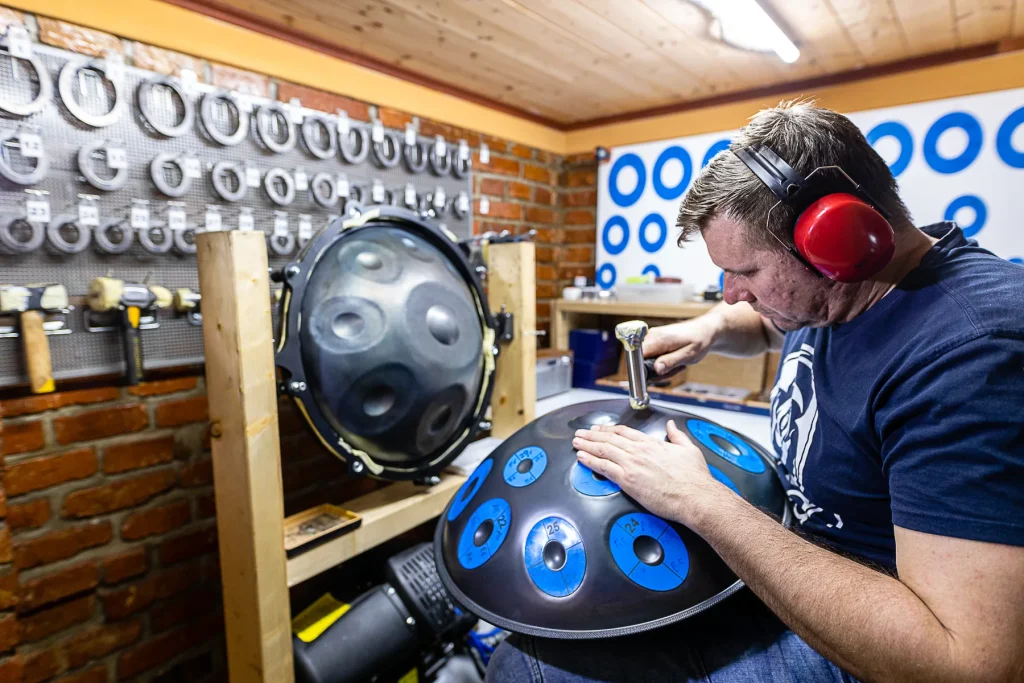
The handpan is a fascinating instrument, prized for its mesmerizing sounds. Regular tuning is essential to preserve its sound quality.
Over time, factors such as impacts or climate variations can alter its notes. Recognizing the signs that it is out of tune allows you to act in time.
This guide helps you identify common problems and choose the right solutions. Based on ten years of expertise, it covers causes, diagnosis, and professional methods.
1. Why does a handpan go out of tune?
Several factors affect the stability of a handpan‘s notes. Steel, its main material, reacts to physical and environmental stresses. Here are the main causes.
Natural causes of detuning
The metal deforms after thousands of strikes. A thickness of 1 to 1.2 mm makes the instrument sensitive to minute changes. This phenomenon is inevitable, but its progression varies with use.
Handling mistakes that make the problem worse
- Harsh playing techniques (ding-bending, hard mallets).
- Accidental impacts (drops, excessive pressure).
- Cleaning with abrasive products.
Poor maintenance accelerates deterioration of the tone fields.
The impact of environmental conditions
Steel expands or contracts with temperature. Exposure to sunlight or moisture throws the notes out of balance. To prevent this:
- Store the instrument in a temperature-controlled location.
- Keep it away from direct heat sources.
Urgent detuning occurs after a severe impact, while gradual detuning develops over a period of 2 to 5 years.
2. How can you tell whether your handpan is out of tune?
Detecting detuning requires careful attention to sonic details. Several methods can be used to assess the accuracy of the notes played.
Checking by ear: signs to recognize
Unusual dissonance between notes is an initial clue. Compare each note with a reference recording. Audible beats (rapid variations in volume) often indicate a problem.
Using an electronic tuner: a precise method
A chromatic tuner provides an objective measurement. Set it to 440 Hz (the standard) or 432 Hz, according to your preference. Here is how:
- Place the instrument in a quiet environment.
- Strike each note and read the displayed frequency.
- Compare it with the target values (e.g., D4 = 293.66 Hz).
Apps such as Spectroid analyze the audio spectrum, but their accuracy is limited. Choose a professional tuner for reliable results.
Interpreting the results (tolerance in hertz)
ISO 16:1975 recommends a tolerance of 0.5 Hz. In practice, a deviation of 10 cents (≈ 5.8 Hz at 440 Hz) remains acceptable. Example:
- Theoretical note: 440 Hz.
- Note played: 446 Hz → deviation of 6 Hz (needs correction).
To learn more about tuning methods, consult this detailed guide.
3. When should a handpan be retuned?
Maintaining sound quality requires regular vigilance. Signs of detuning may be subtle or obvious, depending on use and environment.
Average frequency based on use
High-end models remain in tune for 2 to 5 years, while budget versions require more frequent adjustments. Here is a detailed comparison:
| Instrument type | Handpan tuning frequency | Influencing factors |
|---|---|---|
| High-end (treated steel) | 2 to 5 years | Moderate playing, optimal storage |
| Entry-level | 3 to 6 months | Intensive use, climate variations |
Urgent situations (impacts, drops)
A severe impact causes immediate deformation. Consult a professional if you notice:
- Reduced resonance or a “flat” sound.
- Visible cracks in the note fields.
A drop can make the instrument unplayable without prompt intervention.
Cases where differential tuning is necessary
Contrary to popular belief, changing the original scale is technically impossible. Handpan tuning aims to restore the original frequencies, not transform them.
Energetic percussionists should check their note fields twice as often as occasional players.
4. How is a handpan retuned?
The art of bringing a handpan back to life requires meticulous tuning. This delicate operation demands appropriate expertise and equipment to preserve the soul of the instrument.
The importance of professional expertise
Working with nitrided steel or stainless steel requires specific skills. An amateur attempt can cause irreparable cracks.
“Improper hammering permanently alters the harmonics,” says Josh Rivera of Riviera Steel Tuning.
Essential tools
Here is the equipment used by specialists:
| Tool | Function | Precision |
|---|---|---|
| Tuning hammer | Adjust the note fields | Hardened rubber |
| Spectrum analyzer | Measure frequencies | Accuracy of ±0.1 Hz |
| Luthier’s vise | Stabilize the instrument | Adjustable pressure |
The retuning process
The process follows a rigorous sequence:
- Video diagnosis to identify deformed areas.
- Precise hammering of the fields with a suitable mallet.
- Checking the harmonics with a digital tuner.
The time required ranges from 48 hours to 3 weeks depending on the adjustments. To explore the subject further, discover these proven tuning methods.
5. Cost and choosing a professional to retune a handpan
Investing in professional tuning helps ensure your instrument’s longevity. Prices and services vary according to expertise and specific needs.
Price ranges (€100 to €300 on average)
The cost depends on the complexity of the repairs. Here is a detailed estimate:
| Type of service | Average price | Details |
|---|---|---|
| Standard retuning | €100 to €200 | Correction of 1 to 3 notes |
| Repair after an impact | €250 to €300 | Disassembly included |
Instruments not purchased from certain retailers may incur surcharges (€50).
Criteria for choosing an experienced tuner
A qualified professional offers:
- An audio portfolio with examples of completed work.
- Recognized certifications (e.g., Handpan Academy).
- Verified customer reviews.
Choose local craftspeople to avoid shipping risks.
Warranties and expected turnaround times
Warranties often include:
- 2 years of tuning stability.
- Free retuning if necessary.
Average turnaround times are 3 weeks, including collection and delivery. Always request a tuning certificate after the service.
6. Conclusion: preserving your handpan’s sound quality
A well-maintained instrument delivers optimal sound quality. Check its tuning regularly and store it away from moisture.
Always choose professional repairs. At-home attempts risk permanently damaging your handpan. Consult an expert promptly if in doubt.
To learn more about this unique instrument, see our complete guide.
A forthcoming article will explore the fascinating history of the handpan. Stay tuned to deepen your knowledge of music.