
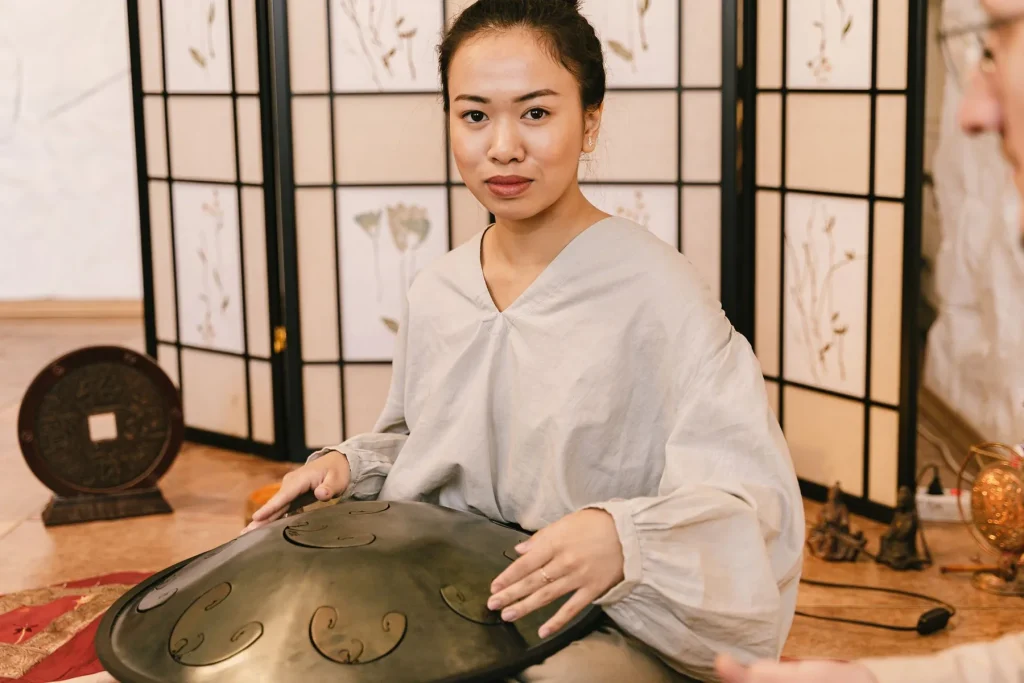
The handpan captivates listeners with its enchanting tones and unique polyphony. This modern instrument offers a wide range of scales, each creating a distinct atmosphere.
Models such as D Kurd and Amara offer different tonalities suited to beginners and experienced musicians alike. Your choice directly affects expressiveness and the emotion conveyed.
Several criteria matter when selecting your instrument: the style of music you play, your technical level, and your budget. Brands such as CosmoPan and Handpan Store offer a variety of options.
Learn how to choose from the different available scales to find the one that suits your musical world.
Introduction to handpan scales
A scale represents the musical soul of an instrument. On a handpan, it consists of a series of notes arranged according to specific intervals. These sequences define the sonic identity of each model.
Unlike a traditional piano, a handpan has between 8 and 12 notes. This physical limitation creates unique combinations in which each tonality plays a key role. The central note, called the “Ding,” establishes the main key.
Scales use two notation systems:
- Solfège (do, re, mi)
- Letter notation (C, D, E), with the octave indicated (D3, D4)
This arrangement directly influences the atmosphere created. An E major scale (E major) produces cheerful melodies, whereas a minor structure evokes melancholy.
To explore concrete examples, discover how the E major scale structures harmonious compositions.
The art of the handpan lies in this alchemy between technical simplicity and emotional richness. Each configuration opens up a distinct world of sound.
Difference between major and minor scales
The music of the handpan stands out for its emotional nuances. Two types of structures predominate: major scales and minor scales. Each has a unique character that influences the atmosphere it creates.
Characteristics of major scales
The notes in major scales follow specific intervals. These sequences produce bright, energizing harmonies. G Equinox is a typical example.
Their structure encourages:
- Cheerful melodies
- A dynamic tempo
- A sense of openness
Characteristics of minor scales
Minor scales use different intervals. D Kurd illustrates this approach well. They generate more introspective tones.
Their popularity is notable: 70% of sales involve this type of configuration. C-sharp minor Annaziska is often chosen for meditative compositions.
Emotions associated with each type of scale
The emotions vary radically depending on the choice:
“Major evokes optimism, while minor touches on nostalgia.”
This diversity makes it possible to adapt the instrument to every mood or musical project. Musicians draw on this palette to create a variety of atmospheres.
The scales best suited to beginners
For newcomers to the world of handpans, some sound configurations are more accessible than others. These choices offer intuitive playability while allowing players to explore rich melodies.
D Kurd: the versatile scale
D Kurd in D minor (D3-A4) is often recommended for beginners. Its widely spaced notes encourage improvisation and meditative rhythms.
Key benefits:
- Natural harmony, even without extensive musical knowledge
- Compatibility with other instruments for easy duets
Amara: a balance between simplicity and expressiveness
With its skipped note (Bb3 to C5), Amara provides a light quality that is ideal for folk or jazz. Its airy melodies quickly win players over.
“Amara allows beginners to play harmonious sequences from their very first sessions.”
Equinox: for a harmonious atmosphere
G Equinox blends major and minor scales. Perfect for creating emotional transitions, it suits beginners looking for variety.
| Scale | Key | Suitable style | Complexity |
|---|---|---|---|
| D Kurd | D minor | Meditation | ★☆☆☆☆ |
| Amara | Bb3-C5 | Folk/Jazz | ★★☆☆☆ |
| Equinox | G major/minor | Transitions | ★★☆☆☆ |
Avoid Eastern scales such as Hijaz for a first purchase, as they are too complex for a relaxed learning experience.
How to choose your handpan scale
Finding the ideal scale for your handpan requires careful thought. Several factors influence this choice, from your musical style to your technical experience. A well-considered selection enhances both playing enjoyment and progress.
Decisive criteria
Your musical style should guide your selection first and foremost. Minor scales such as D Kurd are suited to meditation, while major scales add energy to performances.
Technical ability also matters. Beginners should favor simple configurations such as Amara so they can progress quickly. Experienced musicians can explore complex scales such as Hijaz.
Finally, the budget varies significantly:
- Entry-level models: €500 to €900
- Handcrafted handpans: €990 to €2,050
- Alternatives (steel tongue drums): from €59
Listening: an essential step
Trying several models is crucial. Compare their sounds in a store or through online demonstrations. Brands such as CosmoPan and Handpan Noir offer distinctive tonalities.
“My first D Kurd handpan allowed me to master the basics in three months.” – Expert testimonial
Avoid these common pitfalls:
- Overlooking the tuning frequency (standard 440 Hz versus holistic 432 Hz)
- Forgetting compatibility with other instruments
| Criterion | Priority | Examples |
|---|---|---|
| Musical style | High | Meditation: D Kurd / Performance: Equinox |
| Budget | Medium | €500-€2,050 depending on the finish |
| Level | High | Beginners: Amara / Experts: Pygmy |
Exploring Eastern scales and their unique sounds
Journey through exotic sounds with these special scales. They offer a wide variety of musical colors, ideal for world music compositions or cinematic atmospheres.
Hijaz: the call of the Middle East
This C scale (C-D-Eb-F#) has a melancholic character. Its asymmetrical intervals evoke deserts and Arabic melodies.
Ideal for:
- Creating enchanting atmospheres
- Improvising complex solos
Akebono: the Japanese touch
Inspired by traditional kotos, this pentatonic scale (C-D-Eb-G-Ab) offers a delicate sound. It is perfect for meditation or soothing soundscapes.
“Akebono stands out for its purity, like a musical Zen garden.”
Pygmy: African rhythms
With its notes (D-A-C-D-E-F-G-A-C), this scale reproduces the variations of tribal percussion. Its rhythmic energy is infectious.
| Scale | Notes | Use | Level |
|---|---|---|---|
| Hijaz | C-D-Eb-F# | World music | Intermediate |
| Akebono | C-D-Eb-G-Ab | Relaxation | Beginner+ |
| Pygmy | D-A-C-D-E-F-G-A-C | Percussion | Advanced |
These variations require a certain level of technical mastery. To become comfortable with them, it is essential to explore musical scales.
Tuning frequency: 440 Hz or 432 Hz?
The tuning of the instrument directly influences its harmony and how well it blends with other music. Two standards compete: traditional 440 Hz and alternative 432 Hz. This technical choice affects the playing experience and musical collaborations.

440 Hz: the musical standard
440 Hz has been the international standard since 1953. This frequency ensures perfect compatibility with other instruments, such as pianos and guitars.
Its main benefits:
- Essential for playing in a group
- A wide selection of suitable sheet music
- Stable tuning that is easy to check
432 Hz: for a holistic experience
432 Hz is gaining popularity in sound-therapy circles. Its proponents describe a more “natural” resonance, although no formal scientific evidence supports this claim.
“432 Hz creates a soothing vibration, ideal for deep meditation.”
Which frequency should you choose for your needs?
The choice mainly depends on how you intend to use the instrument:
| Use | Recommended frequency | Example model |
|---|---|---|
| Ensemble music | 440 Hz | CosmoPan Vortex Standard |
| Solo meditation | 432 Hz | CosmoPan Vortex Holistic |
| Studio recording | 440 Hz | Handpan Noir Pro |
Tip: some instruments offer an adjustable tuning system so you can explore both worlds.
Practical advice for buying your first handpan
Choosing your first handpan requires a methodical approach to avoid disappointment. Between reputable makers and offers that seem too good to be true, here is how to navigate the market with confidence.
Where to buy and which makers to favor
Choose certified makers such as Saraz Handpans or authorized retailers such as Handpan Store. These names guarantee hardened steel and durable tuning.
Be wary of anonymous platforms. Always check:
- Detailed customer reviews
- Demonstration videos recorded under real-life conditions
- The presence of a minimum two-year warranty
Budget and value for money
A budget below €900 may expose you to inferior materials. Here is a realistic comparison:
| Price range | Quality | Example |
|---|---|---|
| €500-€900 | Beginner (risk of instability) | Entry-level models |
| €900-€1,500 | Professional | Saraz Basic |
| €1,500 and above | Handcrafted | Instruments du Monde |
“Investing €1,200 in a handpan saved me from costly retuning.” – User testimonial
Avoiding common pitfalls
Common pitfalls include express delivery offers, which are often associated with counterfeits, and unhardened steel. Always request a certificate of authenticity.
For a secure purchase:
- Prioritize in-store trials
- Check the tuning frequency (standard 440 Hz)
- Be wary of excessive discounts
Conclusion
The handpan opens up a world of musical creativity. Your choice of scale influences expressiveness and the emotion conveyed. Prioritize criteria such as your music style, your ability level, and your budget.
For beginners, versatile scales such as D Kurd and Amara offer a gentle learning curve. They allow you to explore rich melodies without excessive complexity.
Useful resources include online tutorials, musician communities, and specialist retailers such as Handpan Store. As the saying goes: “Your instrument should resonate with your soul, not only with your ears.”
Ready to find your gem? Explore our catalog to discover the scale that suits you.