
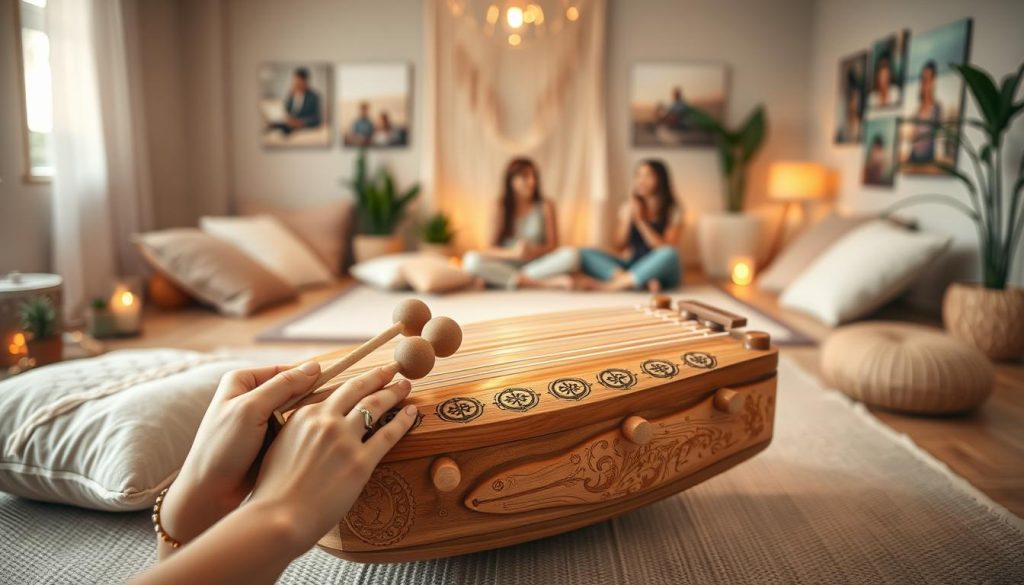
This guide clearly presents the tongue drum and its contributions to well-being. It explains why this percussion instrument is so popular for relaxation and reducing stress.
The tongue drum, sometimes called a steel tongue drum, produces harmonious sounds that encourage relaxation. Easy to approach, this instrument is suitable for beginners and practitioners alike.
We will explain the different steel variants, their range, and how to choose from the available tongue drums. To learn more, see this complete guide on Instruments du Monde.
Understanding the tongue drum and music therapy: what you need to know
The instrument’s distinctive resonance immediately encourages inward listening.
The tongue drum stands out for its intuitive melodies. The notes flow naturally from one to the next, making it easy for beginners to approach.
Each instrument is designed to create an immersive sound experience. The vibration of the metal influences breathing and helps calm the mind.
This modern instrument draws inspiration from ancient practices and relies on acoustic resonance to encourage relaxation. Its simplicity fosters creative expression without requiring complex musical instruction.
- Immediately accessible to all ages.
- Commonly used for meditation and relaxation.
- Technical aspects: frequency, size, and the type of metal influence the tone color.
Growing popularity: practitioners are adopting this instrument for its ability to quickly establish a connection between the player and the instrument, making it useful in individual or group sessions.
Origins and evolution of the tongue drum
The modern history of this steel instrument combines DIY ingenuity and innovation.
Its roots go back to ancient slit drums, which have been used for rituals and meditation for several centuries. These simple percussion instruments inspired modern craftspeople.
In 1990, Jim Doble transformed gas cylinders into the Whale Drum, creating deep sounds. In 2001, a Swiss couple developed the Hang, which influenced the arrangement of notes on metal.
- 2007: Dennis Havlena invents the first modern tongue drum.
- Prototypes: 29 lb (13 kg) propane tanks are used to define the scale.
- Current models use advanced manufacturing techniques to ensure accurate notes.
| Year | Inventor | Material | Impact |
|---|---|---|---|
| 1990 | Jim Doble | Gas cylinders | Low sounds, industrial prototype |
| 2001 | Swiss couple | Formed metal | New note layout |
| 2007 | Dennis Havlena | Worked steel | Modern standardization |
Understanding this evolution helps us appreciate the complexity of the sounds produced by tongues cut into the steel. For a more comprehensive overview, explore the origins of the tongue drum.
Acoustics and sound vibrations
Waves propagating inside the body create this instrument’s distinctive sound. A well-designed body can reach 70 to 80 decibels, which is sufficient for playing in a small group.
Each note comes from a vibrating tongue: its length and mass determine its frequency and depth. The scale is set during manufacturing to ensure that all the notes harmonize.
The vibrations spread and generate the rich resonance characteristic of the sounds produced by these percussion instruments. Large models offer deeper timbres, while smaller ones allow faster, more precise playing.
- Volume: 70–80 dB depending on the body.
- Accuracy: tuning every note is crucial to a soothing experience.
- Expression: the resonance opening changes the timbre in real time.
The design distributes vibrations optimally, immersing the listener in the music. To explore the subject further, see this complete guide on Instruments du Monde.
Therapeutic benefits for body and mind
Playing this instrument creates a soundscape conducive to relaxation and emotional regulation. Regular practice has measurable effects on the body and mind.
Reducing stress and anxiety
Frequent practice reduces stress levels by encouraging deep relaxation. The gentle vibrations stimulate the production of feel-good hormones.
Many therapy centers use these percussion instruments to soothe anxiety and lower blood pressure.
Improving concentration
Listening closely to the sounds helps anchor the mind in the present. During yoga or meditation, the tongue drum makes it easier to concentrate.
This gradually developed concentration carries over into everyday tasks and improves working memory.
Effects on sleep
The soothing timbres of the steel tongue drum promote restorative sleep. A short session before bedtime helps prepare the body for rest.
In practice, regular use reduces nighttime awakenings and improves sleep quality in adults.
- Relaxation accessible at every skill level.
- Calming effect on muscular and emotional tension.
- A simple tool for practitioners and home use.
Essential criteria for choosing an instrument
Choosing the right instrument begins with understanding how frequency and scale influence emotions. These two parameters determine the atmosphere of each session and how the body responds to sound.
The importance of frequency and scale
440 Hz remains the Western tuning standard. However, several manufacturers offer models tuned to 432 Hz, which are sought after for their relaxing effect.
The scale directly affects the mood: major scales sound bright, while minor scales create a more introspective tone.
- Material: a steel instrument provides long-lasting resonance.
- Number of notes: from 6 to 15 notes depending on the desired melodic complexity.
- Diameter: the larger it is, the deeper the vibrations.
- Scale: choose a minor scale for meditation and a major scale for sociable playing.
Practical guide: explore our selection to avoid common purchasing mistakes and find the best steel tongue drum for your needs: best steel tongue drum models.
Meditation techniques and music-therapy practice
The targeted use of pentatonic patterns makes it easier for beginners to enter meditation. The pentatonic scale avoids wrong notes and creates a safe setting for sound exploration.
Begin with slow, regular strikes synchronized with your breathing. This method amplifies the vibrations and promotes concentration.
During therapy, this instrument guides patients toward sustained attention. Repeated sounds balance emotions and reduce stress.
Regular practice makes it possible to learn advanced techniques without reading sheet music. Players develop a keen ear for notes and gain immediate freedom of expression.
- Use the pentatonic scale for yoga and mindfulness.
- Start with short sessions of 5 to 15 minutes, then gradually increase their duration.
- Combine sound and breathing to enhance the calming effect.
For guided exercises and session ideas, discover how to meditate with this instrument. Each note helps create an atmosphere conducive to inner peace.
Advice for beginners and schools
A good initial choice makes learning easier and encourages classroom practice. For schools, prioritize simplicity, durability, and a size suited to small hands.
Choosing the ideal model
15 notes let players perform most of the sheet music available online. A model made of steel provides enduring resonance and holds up well over time.
For children, a diameter of 6 to 8 in (15 to 20 cm) is recommended. The steel tongue drum remains easy to use and produces harmonious sounds from the very first minutes.
Educational use with children
The instrument encourages concentration and musical awareness. Teaching a few basic techniques helps students understand how notes and scales are structured.
- Suitable for group workshops and individual sessions.
- Durable enough for frequent use in schools.
- Encourages creativity and a calm classroom atmosphere.
| Criterion | Recommendation | Benefit |
|---|---|---|
| Number of notes | 15 | Broad playable repertoire |
| Diameter | 6–8 in (15–20 cm) | Easy for children to handle |
| Material | Steel | Stable resonance and durability |
For classroom activity ideas and musical games, see this educational workshop.
Conclusion
Ultimately, its simple notes and deep vibrations open a path toward serenity in everyday life.
The tongue drum has become an essential instrument for anyone wishing to incorporate relaxation into daily life. Its harmonious notes make it easier to reach a state of calm and reduce stress.
Whether you are a beginner or a musician, this instrument offers an intuitive gateway to well-being. Investing in a quality model turns every session into a lasting moment of peace.
To learn more, see a complete guide and a handpan comparison to help you choose the scale that speaks to you.