
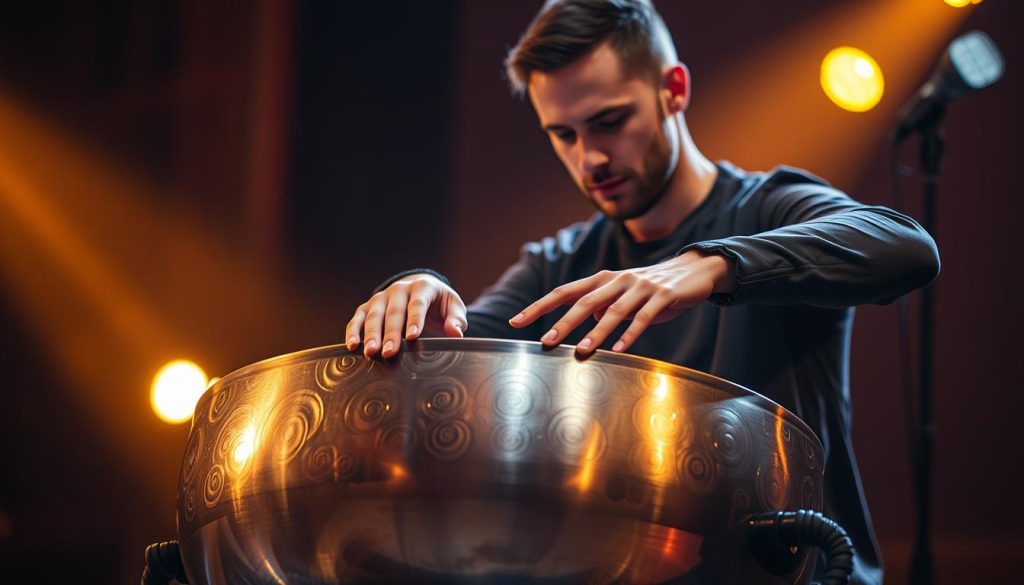
The handpan is a fascinating instrument that creates mesmerizing melodies. Its unique tone captivates listeners and transforms every performance into a memorable experience.
A successful demonstration combines technique and emotion. Renowned teacher David Charrier shares methods proven by thousands of musicians.
Whether you are a beginner or an experienced player, these tips will help you create a harmonious show. Audience interaction and sonic immersion are key elements.
1. Preparing Your Handpan Demonstration: The Essential Foundations
Choosing the right handpan and repertoire is essential for a successful performance. A well-tuned instrument suited to your style will make all the difference. Here is how to lay the foundations for a memorable performance.
Choosing the Right Instrument and Repertoire
The ideal handpan depends on its tuning (440 Hz or 432 Hz) and the number of notes. Standard models have 9 to 10 notes, such as the D Kurd. The central note determines the main key.
Adapt your repertoire to the instrument’s range. For example, a D Kurd scale is suitable for meditative melodies. To learn the handpan on your own, choose simple pieces.
Understanding Musical Notation to Structure Your Performance
Simplified music theory makes learning easier. Visual systems use numbers (1 = D3), symbols, or colors. A printable exercise booklet can guide your rehearsals.
Include percussive effects such as slaps (S) or dings (D) in your scores. This adds dynamics to your playing.
With a good method, even beginners progress quickly. The key is to practice regularly and enjoy yourself.
2. Mastering Playing Techniques to Captivate Your Audience
Sound effects and rhythm transform a simple melody into an immersive experience. To move your audience, combine precision with expressiveness.
Using Percussive Effects
Techniques such as the slap (S) or ghost note (-) add texture. Here are the 8 main effects:
- Slap: a sharp percussive sound used to mark an accent.
- Ghost note: a muted note that reinforces the pulse.
- Palm mute (P): resonance controlled with the palm.
Practice each effect separately before combining them. For example, use a “1-3-5” pattern with variations.
Working on Rhythm and Dynamics
Timing and silence create emotion. Adapt your playing to the tempo:
| Tempo (BPM) | Effect | Application |
|---|---|---|
| 60 | Meditative | Slow introductions |
| 80 | Balanced | Versatile pieces |
| 100 | Energetic | Powerful finales |
Dynamic accents (forte/piano) guide the audience’s attention. A progressive method helps you master these nuances.
3. Organizing a Handpan Demonstration: Staging Your Performance
Staging a handpan performance requires a thoughtful approach to captivate the audience. The sequence of melodies and strategically placed pauses creates a musical narrative.
Creating a Logical Progression
The simple-to-complex approach, tested by 38,000 students, is ideal. Begin with simple patterns before introducing advanced techniques. For example:
- First section: a slow piece to set the mood.
- Second section: gradual acceleration with percussive effects.
- Finale: an energetic medley featuring familiar covers.
This proven guide, detailed on Masterthehandpan, ensures a seamless immersive experience.
Including Interactive Moments
Involve the audience to build confidence. Lead a rhythmic handclapping sequence or share an anecdote between two pieces. These pauses create a unique connection.
“A personal story transforms a performance into a musical conversation.”
Structure your 30-minute performance around five themed pieces. Alternate solos with participatory moments to maintain attention.
4. Optimizing the Space and Equipment for an Immersive Experience
A handpan’s sound quality depends greatly on the environment in which it is played. A good acoustic setup and suitable equipment will make your performance much more captivating.
Choosing the Ideal Venue
The use of a space with suitable characteristics is essential. Here are the factors to consider:
- Ceiling height: a high ceiling reduces excessive reverberation.
- Materials: favor absorbent surfaces (wood and fabrics) for a warm sound.
- Layout: avoid right angles that create echoes.
For reverberant spaces, movable acoustic panels provide a practical solution. Outdoors, an anti-vibration mat stabilizes the instrument.
Providing a Suitable Sound System
The need for amplification varies according to the venue’s size. Here is a typical setup for 100 people:
| Component | Recommendation |
|---|---|
| Microphones | Cardioid (sound isolation) |
| PA system | With controlled reverberation |
| Feedback management | Notch-filtering technique |
Basic training in acoustics helps you anticipate problems. The theory of sound waves guides speaker placement.
5. Engaging Your Audience: Tips for a Memorable Demonstration
Transforming a simple demonstration into an interactive experience is a subtle art. The handpan offers unique opportunities to create this magical connection with the audience.
Telling a Story Through Melodies
Your performance becomes a sonic journey when you structure the pieces like a story. Begin with low, slow notes to set the mood.
Gradually introduce rhythmic variations like plot twists. This method transforms passive listening into an active experience.
“A well-crafted melody is like a book in which every chapter reveals a new emotion.”
Involving the Audience with Simple Exercises
Here are three proven techniques:
- Call & Response: play a simple phrase and invite the audience to repeat it by clapping.
- Soundscape: use smartphones to create a harmonic background.
- Guided improvisation: suggest patterns that the audience can complete.
These interactions provide shared enjoyment and make the show even livelier.
| Technique | Ideal Duration | Required Level |
|---|---|---|
| Call & Response | 3 to 5 min | Beginner |
| Group playing | 5 to 7 min | Intermediate |
| Live creation | 8 to 10 min | Advanced |
These methods not only engage the audience but also allow you to vary the energy. Adapt the number of exercises to your program.
Conclusion
Sharing your passion requires preparation and authenticity. The five pillars—instruments, techniques, staging, space, and engagement—ensure a memorable experience.
Test these methods at events such as the Handpan Festival France. As Léa, a student for six months, explains: “By devoting time to it, I gained confidence in my hands, and now I play for friends.”
The featured courses offer a money-back guarantee. In your case, will you dare to share your creations in public?