
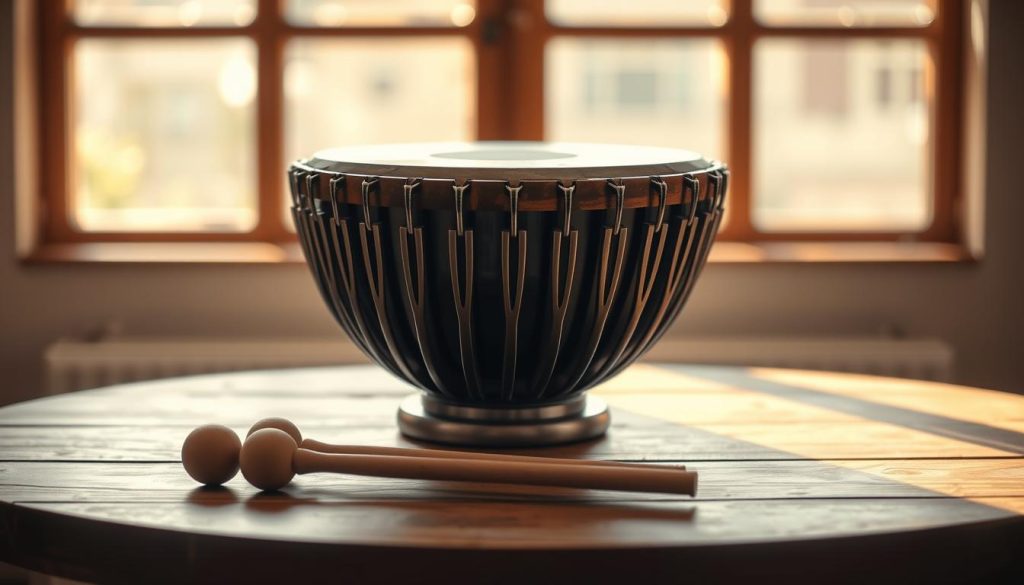
Discovering this instrument, with its modern design and soothing sounds, opens the door to meditation and musical creativity. This guide explains its origins, purpose, and the way it produces notes in simple terms.
Designed as a percussion idiophone, it offers an accessible experience for beginners. It is often used for relaxation, yoga, or music therapy because its tone encourages presence and calm.
In just a few minutes, you can learn basic patterns and experience benefits for mental clarity. This short article serves as a guide to comparing models, understanding their construction, and choosing one according to your needs.
For a more detailed historical and technical overview, see the dedicated article on Wikipedia.
What Is a Steel Tongue Drum? Definition and How It Works
Metal tongues cut into the surface produce this instrument’s unique tone. Striking these tongues triggers vibrations that create the warm, sustained sound appreciated by so many people.
Often called a tank drum, it is made by joining two metal shells to form a resonant chamber. Each tongue is calibrated to produce a specific note, ensuring natural harmony while playing.
This modern instrument has evolved from prototypes made with gas cylinders into refined models designed for music and relaxation. Its construction requires precise metalworking to ensure that the notes sustain properly.
Accessible to beginners, the tongue drum makes improvisation easy. To learn more about the available models and how to choose one, read everything you need to know about the tongue drum.
The Historical Origins of the Tongue Drum
The tongue drum’s roots can be traced to slit drums that have been used for centuries. These slit drums served communication, ritual, and folk-music purposes.
The Influence of Slit Drums
Ancient slit drums inspired its shape and acoustic principle. Simple to make, they demonstrated how a slit could produce a rich, clear sound.
Dennis Havlena’s Invention
In 2007, Dennis Havlena brought this idea to life by creating the first modern model from a propane tank. He also used neodymium magnets to adjust the notes of his prototypes, a technique that is still discussed today.
“The process of cutting tongues into a shell produces a different tonal color from the one created by hammering handpans.”
| Milestone | Year | Contribution |
|---|---|---|
| Slit drums | For more than 500 years | Acoustic foundation and cultural use |
| Whale Drum (Jim Doble) | 1990 | Modern precursor |
| Hang (Rohner & Schärer) | 2000 | Influence on handpans |
| D. Havlena | 2007 | Birth of the modern steel tongue drum |
Sound Production and Acoustic Mechanism
Every vibration begins when the metal surface is set in motion by a strike. By touching a tongue, the player creates a vibration that excites the inner chamber. This action projects the sound into the air.
The Role of the Resonating Chamber
The resonating chamber, formed by two welded shells, amplifies the sound of the tongues. A 25 cm model generally reaches between 70 and 80 decibels, depending on whether it is played with the hands or mallets.
Each tongue is cut to precise dimensions. Smaller tongues produce higher notes, while larger ones produce lower sounds.
The surface forms the foundation for the vibrations. The sound hole allows the wave created inside the chamber to escape, producing the sustained, clear effect valued in music.
- Material quality: the tone depends on the type of steel and the precision of the cuts.
- Modern techniques: current machining methods ensure reliable tuning without external magnets.
- Playing method: hands and mallets affect the attack and duration of the note.
“A good instrument combines accurately cut tongues with a well-designed chamber to produce a rich, enduring tone.”
The Therapeutic and Relaxing Benefits of Playing
Playing this instrument regularly calms the mind and quickly reduces everyday tension.
Effects on stress: playing the tongue drum reduces anxiety and promotes restorative sleep. Its vibrations create a stable soundscape that can help lower blood pressure.
Therapeutic use: in music therapy and sound therapy, its gentle sounds support guided relaxation.
Playing is well suited to yoga and mindfulness. These easy-to-play instruments are suitable for children and adults alike. They stimulate coordination and creativity.
- Relaxation: quickly establishes a peaceful state.
- Expression: an accessible practice that builds creative confidence.
- Therapy: useful in individual or group sessions.
“Focusing on the music provides an escape from everyday pressures and a genuine opportunity to pause.”
To explore its uses and benefits in greater depth, read this practical guide to the 432 Hz tongue drum.
Essential Criteria for Choosing Your Instrument
A good choice depends on the relationship between size, notes, and tuning. Understanding these factors will help you find a model that suits your practice, whether it is intended for relaxation, yoga, or composition.
Number of Notes
9 notes are suitable for beginners, offering simple melodies and a quick introduction to playing.
15 notes provide more harmonic possibilities for performing complex pieces.
The Importance of Diameter
A 40 cm model produces lower, more resonant sounds.
A small 20 cm model supports faster, more precise patterns.
Reference Frequency
The standard reference pitch is 440 Hz. For therapy, many people prefer 432 Hz because they consider this frequency gentler on the ear.
- Surface: high-quality steel ensures a better tone and longer note sustain.
- Base: rubber feet prevent vibrations from being lost through a hard floor.
- Scale: choose the scale according to the intended use.
“Try several diameters before investing so that you can hear the difference in tone.”
For a complete practical overview, see this detailed guide.
A Guide for Beginners and Children
For young beginners, a small model makes musical discovery easier from the very first lesson.
Practical advice: choose a 15–20 cm instrument for elementary-school children. This size is lightweight, easy to hold, and ideal for developing motor skills.
A set of 9 notes in a minor scale is ideal for beginners. It offers enough melodic possibilities without theoretical complexity.
In schools, this percussion instrument encourages creativity, concentration, and cooperation. Simple exercises help reduce stress and introduce relaxation in the classroom.
- Tuning: a properly tuned tank drum can be played without an advanced knowledge of music theory.
- Use: practical for workshops, yoga sessions, and music therapy for children.
- Benefits: confidence, listening skills, and enjoyment of playing.
“Start small and play often: consistency creates the desire to improve.”
To discover suitable resources and models, see our practical tongue drum guide.
Understanding the Nuances Between Musical Scales
Choosing a scale means choosing the sonic soul of your instrument. The combination of notes creates the emotional color that will guide your playing.
The major scale produces a bright, cheerful sound. The minor scale favors more introspective melodies, often used in therapy or yoga.
Since 2018, the Beat Root Multi-Scale has made it possible to switch between six scales on a single instrument. This innovation is a major development for musicians who want to vary their sounds without acquiring several instruments.
The pitch of each note is set at the factory. Changing the scale after manufacture remains difficult. This choice is therefore often a long-term commitment.
Many beginners enjoy the Amara and Hijaz scales for their meditative character. They offer an ideal tonal range for relaxation, simple composition, and sound therapy.
“Choosing the right scale transforms the playing experience: it shapes the emotion, technique, and use.”
| Aspect | Major | Minor |
|---|---|---|
| Mood | Bright, joyful | Introspective, gentle |
| Recommended use | Games, joyful ceremonies | Yoga, meditation, therapy |
| Possibility of modification after manufacture | Low | Low |
To compare these differences with other instruments and choose your model more confidently, read our article on the difference between a handpan and a tongue drum.
Key Differences from the Handpan and Hang
The Hang, invented in 2000 by Felix Rohner and Sabina Schärer, is a distinct instrument whose tone fields are shaped by hammering the surface.
This technique contrasts with that of cut-tongue models, which use precut slits to produce each note. The manufacturing method directly affects both tone and price.
In practice, the handpan requires a more refined manual technique to produce the correct pitch. The nuances of attack are subtle, and each movement must remain delicate.
By contrast, the tongue drum is often played with mallets, making it more accessible to beginners. It remains popular today for its rounded sound and ease of use.
Understanding these differences helps you choose the right instrument for performance, recording, or relaxation.
“The choice between a handpan and a tongue drum depends on the desired playing style: manual finesse or accessible expressiveness.”
| Criterion | Handpan or Hang | Tongue drum | Result |
|---|---|---|---|
| Manufacture | Precision hammering | Calibrated cuts | Difference in tone and cost |
| Playing technique | Hands only, delicate touch | Hands or mallets | Accessibility or subtle expressiveness |
| Price | Generally high | More affordable | Choice according to budget |
| Use | Concerts, recordings | Relaxation, education, studio | Different contexts of use |
To explore its features in greater depth and make an informed choice, see our complete tongue drum guide.
Conclusion: The World of the Tongue Drum
Practical, portable, and intuitive, the tongue drum is suitable for anyone who enjoys relaxing music. Its short learning curve makes it an ideal choice for beginners and experienced players alike.
Understanding its construction, history, and different scales helps you choose a suitable model, whether you want a small tank drum for playing at home or a more comprehensive instrument.
The tone of the steel tongue drum offers a beautiful balance between relaxation and creativity. This guide aims to explain how it differs from the handpan and help guide your purchase.
To learn more, see our complete tongue drum guide. Thank you for reading this article, and may music accompany your moments of relaxation and creativity.